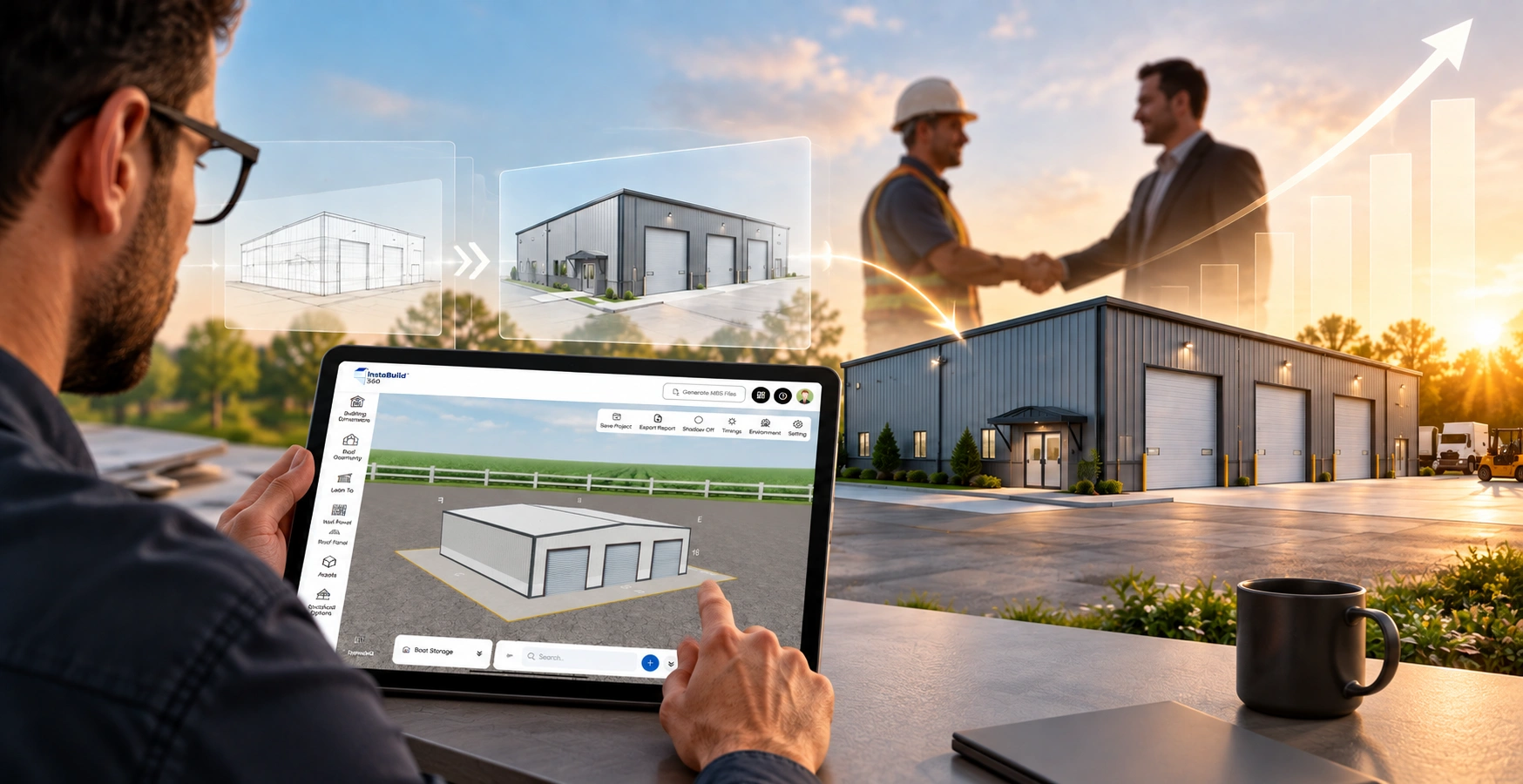
Two proposals arrive on the same decision-maker’s desk. Both are for an 80 × 150 warehouse. Both specify 26-gauge panels. Pricing differs by less than two percent. One proposal receives immediate approval. The other receives no response.
This scenario is familiar to anyone managing a dealer network across North America. The lowest-priced proposal does not consistently secure the business. More often, the deciding factor is the quality of the buying experience.
The highest-performing Pre-Engineered Metal Building (PEMB) companies do not succeed by applying greater sales pressure. They succeed by reducing complexity throughout the purchasing journey. They respond while buyer intent remains high, present transparent and itemized pricing, enable buyers to visualize the proposed building in real time, and conduct follow-up conversations that add measurable value rather than simply requesting a decision.
As competition intensifies, buyer experience increasingly becomes the differentiating factor between winning and losing opportunities.
Key Takeaways
- Why close rates in the PEMB industry are driven more by speed, clarity, and buyer confidence than by price alone.
- How fragmented sales workflows reduce credibility and slow purchasing decisions.
- Why visual selling accelerates buyer understanding and shortens sales cycles.
- How quote-readiness preserves buying momentum.
- Why integrated workflows across sales, estimating, and engineering protect both profitability and operational efficiency.
Speed, Clarity, and Confidence Drive Buying Decisions
A PEMB purchase represents far more than square footage. Buyers are investing in facilities that must support specific operational requirements, whether accommodating overhead cranes in a manufacturing plant, future racking within a warehouse, or precise clearance requirements for an aircraft hangar.
Every customer begins the evaluation process with fundamental business questions. Will the building support current operational needs? Can it accommodate future growth? How should openings, insulation, and interior layouts be configured? Will today’s investment remain suitable five or ten years from now?
The quality and speed of the answers significantly influence buyer confidence.
When responses are delayed, incomplete, or difficult to understand, perceived risk increases. Conversely, when information is delivered quickly through clear visualizations, structured pricing, and well-defined recommendations, buyers gain confidence in both the proposed solution and the supplier delivering it.
Leading PEMB manufacturers consistently distinguish themselves through rapid response times, transparent pricing, immersive 3D visualization, streamlined engineering and permitting support, and disciplined follow-up processes. Sustainable competitive advantage is created not by excelling in one of these areas, but by executing all of them consistently.
Speed represents the first competitive advantage. Most buyers simultaneously engage multiple suppliers during the evaluation process. The organization that responds first with a credible, buildable solution frequently establishes the benchmark against which all subsequent proposals are measured.
Current B2B data shows how rare that speed is. A study of 939 B2B SaaS companies finds that the average B2B lead response time is 47 hours, with only 23% of companies responding within five minutes of inquiry. (Source: Cirrus Insight) In PEMB, where every inquiry is custom, 47 hours means the buyer has already toured another supplier’s 3D model.
The Hidden Cost of Traditional Sales Workflows
Traditional PEMB sales processes were not intentionally designed to be inefficient. Rather, inefficiencies have accumulated over time as responsibilities became distributed across disconnected systems and multiple organizational handoffs.
Customer requirements are captured through email or telephone conversations, recreated in CAD, manually transferred into estimating systems, incorporated into proposal documents, and subsequently reviewed by engineering. If structural constraints require revisions—for example, adjustments to bay spacing or clear height—the process begins again.
Each handoff introduces opportunities for inconsistency. Door locations shift, insulation quantities are overlooked, structural assumptions change, and proposal details gradually diverge from the buyer’s original requirements.
While considerable effort may be invested in completing the proposal, buyers often experience the process as fragmented and inconsistent, reducing confidence in the supplier’s ability to execute the project successfully.
Leading manufacturers address this challenge by establishing a unified digital workflow.
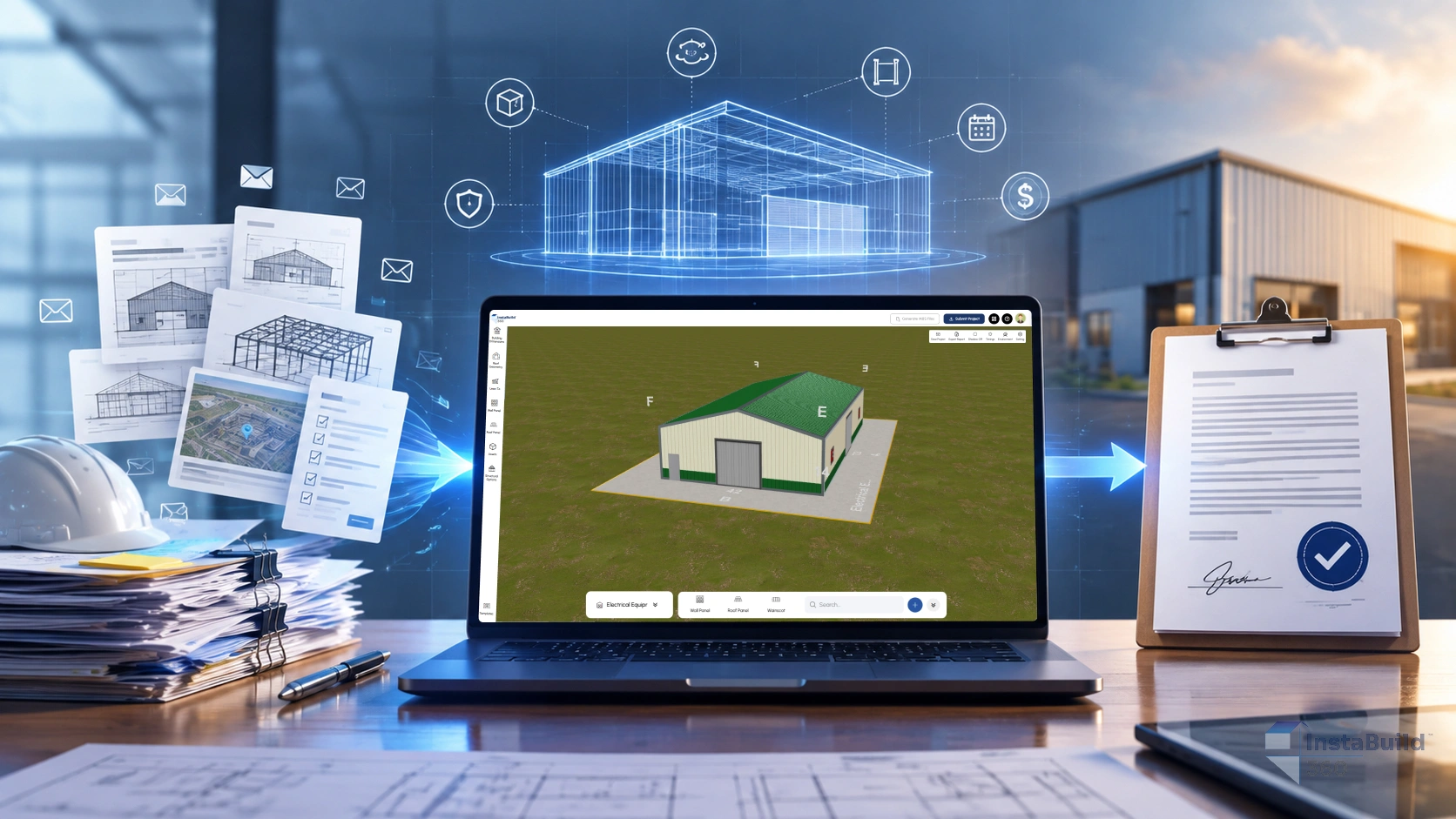
Within a browser-based platform such as InstaBuild360, sales, engineering, and buyers collaborate using the same live building configuration. Engineering intelligence is embedded directly into the configuration process, preventing technically infeasible combinations before they enter downstream workflows. When buyers request design modifications—such as changing the roof profile from symmetrical to single-slope or adding a canopy—the model updates immediately without requiring drafting revisions or engineering intervention.
Once configuration is complete, information is transferred directly into CRM and estimating systems as structured data rather than being recreated manually. Consequently, the design presented by sales becomes the same design used for pricing, engineering, and project delivery.
And when configuration is done, it does not get retyped. It moves as structured data into CRM and estimation. What sales promised is what estimating prices and what engineering details. That continuity is uncommon. Recent testing in 2025 found that only 365 companies responded at all to demo requests, with an average response time of 1 day, 5 hours, and 17 minutes, and just two follow-ups on average. (Source: Cirrus Insight)
Why Visualizing the Building Is More Effective Than Describing It
Few buyers are prepared to approve a significant capital investment based solely on a floor plan. While technical drawings communicate dimensions and layout, they provide limited insight into the building’s architectural appearance, operational functionality, or relationship to the surrounding site.
A floor plan cannot effectively illustrate trim details, wall profiles, roof geometry, traffic flow, or how the completed facility will integrate with access roads, parking areas, and adjacent structures. As a result, buyers are expected to bridge these gaps through interpretation. That uncertainty often delays purchasing decisions.
Interactive visualization fundamentally changes this experience.
Real-time 3D models allow buyers to examine the proposed building from every angle, inspect structural components by selectively viewing wall and roof systems, reposition openings, evaluate sunlight and terrain conditions, and assess multiple building layouts for future expansion. A manufacturing executive can understand equipment movement throughout the facility, while a commercial developer can evaluate how the building complements the surrounding property.
This level of visibility shifts the buying conversation from assumptions to informed evaluation. Rather than focusing exclusively on price, buyers begin assessing operational suitability, long-term value, and project quality.
Within InstaBuild360, visualization is not produced as a marketing rendering after design completion. It is generated directly from the engineering-aware configuration model itself. Every visualization reflects a precise, code-compliant representation of the proposed building, allowing buyers to make decisions based on what will actually be delivered rather than what they imagine.
The Strategic Importance of Quote-Readiness
Quote-readiness represents the period between a buyer expressing interest and receiving a proposal that is both commercially accurate and technically feasible.
In traditional workflows, this stage frequently becomes the longest and least predictable part of the sales process. Sales teams depend on engineering to validate clear heights, bay spacing, crane loads, structural compatibility, and accessory selections before pricing can proceed. Each revision introduces additional delays, extending the time between initial engagement and final proposal.
By the time a technically complete quotation reaches the buyer, purchasing momentum has often weakened.
Leading PEMB manufacturers approach this stage differently. Rather than allowing engineering validation to occur after configuration, they incorporate it directly into the sales conversation.
Live configuration enables sales teams to modify designs while engaging with buyers instead of scheduling revisions for later. Embedded engineering validation confirms feasibility immediately, ensuring that every proposed configuration reflects practical construction requirements. When essential dimensions have not yet been defined, conversational AI assists buyers by generating an appropriate baseline design and recommending technically feasible alternatives whenever requested specifications fall outside available parameters.
This capability significantly compresses the time required to produce a quote-ready proposal while maintaining engineering integrity throughout the process.
Sustaining momentum also depends on the quality of post-meeting engagement. Momentum also depends on persistence after the first call. Most reps stop too early. Research compiled for 2026 shows that 80% of B2B deals require 5 or more follow-ups to close — yet 92% of reps quit after four attempts or fewer. (Source: MARTAL Group)
When the model is live, follow-up does not feel like chasing. The team sends an updated 3D link with the lean-to the buyer requested, or an itemized summary with the new window added. That is substantive. Buyers reply to substance.
Also Read: Why Some PEMB Companies Close Three Times More Deals Than Others
Integrated Workflows Protect More Than Efficiency—They Protect Profitability
The most significant financial risks associated with a project rarely emerge during the sales process itself. Instead, they become apparent after the contract has been awarded.
In disconnected environments, customer requirements are captured within one application, reconstructed by estimating teams in another, and recreated again during engineering. Each manual transfer increases the likelihood of information loss, inconsistencies, and costly downstream corrections.
These discrepancies often appear as field coordination issues, incorrectly positioned anchor bolts, omitted openings, overlooked accessories, requests for information (RFIs), project delays, and avoidable rework. Beyond their direct financial impact, such issues erode customer confidence and reduce project profitability.
Integrated workflows address these challenges by maintaining a single, structured source of project information throughout the entire delivery lifecycle.
Within InstaBuild360, customer-driven configurations generate structured datasets that transfer directly into CRM and estimating systems without manual re-entry. Embedded engineering intelligence prevents non-buildable configurations from progressing, while enterprise-ready integration with ERP, CRM, and construction management platforms ensures that design, estimating, sales, and project delivery remain synchronized from the initial inquiry through fabrication.
Industry data reinforces the importance of this approach. According to PlanRadar, construction rework accounts for between 3% and 11% of total project costs worldwide. For a typical PEMB project, even the lower end of that range represents a substantial reduction in profit, excluding the additional impact of schedule delays and customer dissatisfaction.
Supported by SOC 2 Type I Compliance and rigorous quality engineering practices, InstaBuild360 enables enterprise organizations to combine operational speed with the reliability and governance expected across complex manufacturing environments.
Experience a More Effective PEMB Sales Process
The Pre-Engineered Metal Building market is projected to expand significantly over the coming decade. As demand increases, competitive advantage will belong to manufacturers that simplify complex buying decisions and provide customers with a faster, clearer, and more credible path from inquiry to project approval.
Speed demonstrates respect for the buyer’s time. Clarity reduces uncertainty during evaluation. Visual proof reinforces confidence that the proposed solution accurately represents the finished building. Integrated workflows reflect the operational maturity required to deliver projects consistently and at scale.
Collectively, these capabilities create a buying experience that distinguishes high-performing manufacturers from competitors relying on traditional sales processes.
InstaBuild360 was developed to support this evolution. By combining AI-assisted guidance, real-time 3D visualization, and embedded engineering intelligence within a browser-based platform, it enables manufacturers to modernize how metal building projects are configured, sold, and delivered.
For business leaders evaluating dealer performance and sales effectiveness, the greatest opportunity rarely lies in reducing prices. More often, it lies in reducing buyer uncertainty, accelerating decision-making, and delivering a purchasing experience that builds confidence at every stage of the sales journey.
Organizations seeking to improve win rates can explore the InstaBuild360 platform through an executive demonstration to understand how a visual, structured, and engineering-aware sales process contributes to stronger conversion performance.