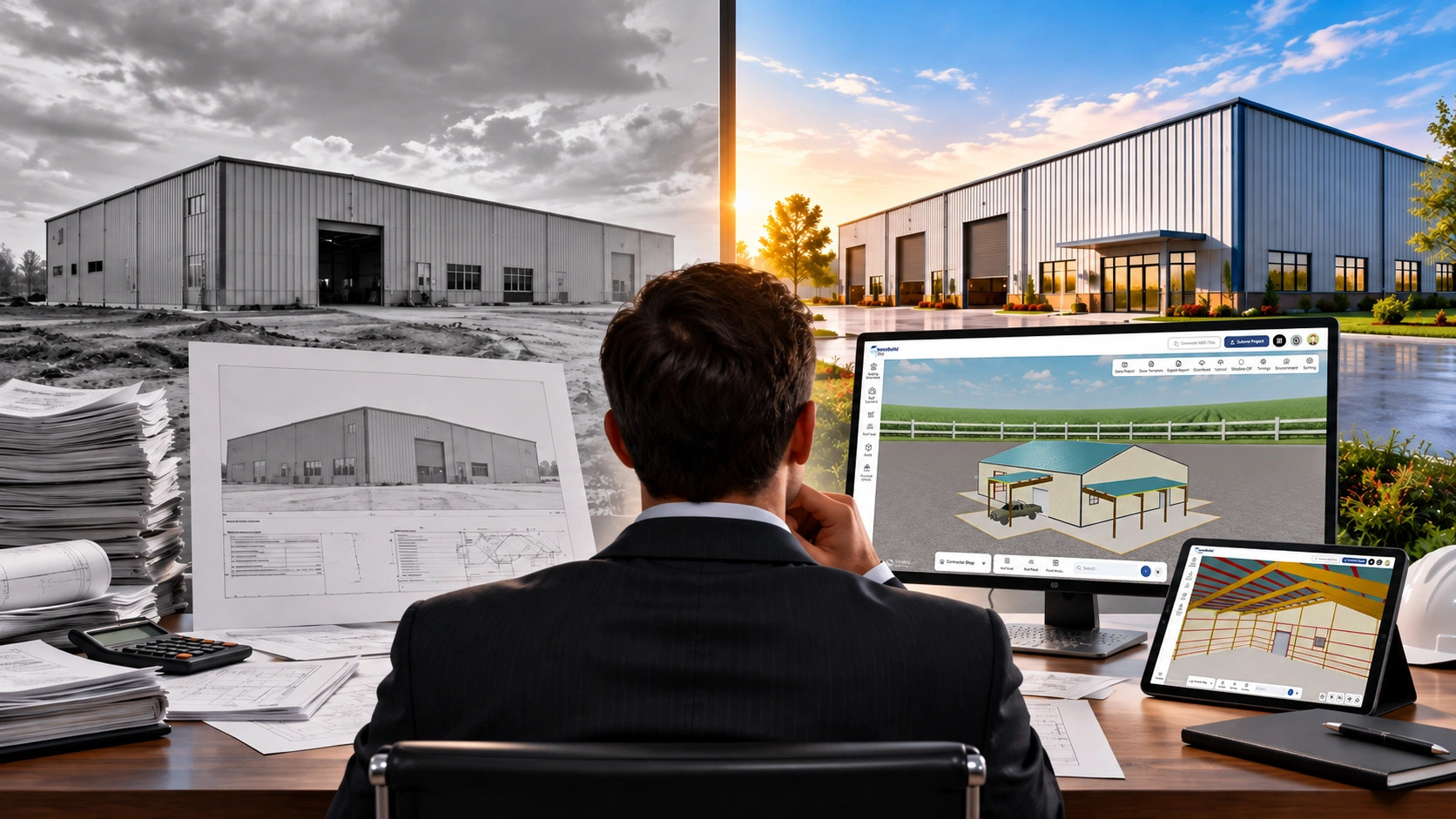
Price becomes the deciding factor when competing proposals appear indistinguishable.
When every proposal consists of a spreadsheet of line items accompanied by a static floor plan, buyers have little basis for evaluating differences beyond cost. In those situations, pricing naturally becomes the primary decision criterion.
This is not simply a pricing challenge. It is a buyer experience challenge.
Leading Pre-Engineered Metal Building (PEMB) manufacturers differentiate themselves by delivering a buying experience that is clearer, faster, and more professional. They reduce uncertainty through interactive visualization, accelerate decision-making with responsive engagement, and establish confidence before the quotation is finalized.
The building itself may be similar. The way it is communicated, understood, and evaluated is what determines competitive advantage.
InstaBuild360 serves as a 3D engineering platform and workflow enablement solution that enables sales, estimating, and engineering teams to demonstrate professionalism throughout the buying journey, not only after pricing has been completed.
Key Takeaways
- Why buyers focus on price when project scope, quality, and execution risk are difficult to distinguish.
- How static proposals and delayed responses make competing suppliers appear interchangeable.
- Why real-time 3D visualization and engineering-aware configuration establish credibility early in the buying process.
- How professional digital engagement reduces buyer uncertainty and accelerates purchasing decisions.
- Why buyer experience has become one of the strongest competitive differentiators for modern PEMB manufacturers.
Why Price Becomes the Default Decision Criterion
Purchasing a pre-engineered metal building is a significant business investment involving operational, financial, and project delivery risk.
Buyers must evaluate whether the proposed facility satisfies structural requirements such as clear heights, crane capacities, bay spacing, wind and snow loads, and future expansion objectives. When competing proposals specify similar dimensions and material specifications but provide limited visibility into scope or technical feasibility, buyers have few meaningful criteria for comparison beyond price.
Traditional proposal formats reinforce this challenge.
Static PDF drawings require buyers to interpret design intent independently, while lump-sum quotations often provide limited transparency regarding what is included within the proposed scope. When buyers must rely on assumptions, uncertainty increases. That uncertainty frequently leads organizations to reduce perceived risk by selecting the lowest-priced proposal.
Market conditions continue to reinforce this behavior. JLL’s 2025 Global Construction Outlook reports that industrial and logistics organizations remain highly disciplined in capital allocation, increasingly favoring suppliers that reduce uncertainty surrounding project scope and delivery schedules. In many purchasing decisions, uncertainty—not material cost—is the primary driver of price sensitivity.
Also Read: 8 Ways InstaBuild360 Simplifies Custom Building Sales for Building Manufacturers
How Limited Visualization Makes Suppliers Appear Interchangeable
Technical drawings communicate dimensions but rarely communicate value.
A conventional floor plan cannot effectively illustrate architectural proportions, brand identity, site integration, traffic flow, or the operational impact of design decisions. It cannot demonstrate how specific wall panel selections complement architectural finishes, how a revised overhead door location affects facility operations, or how the completed building will relate to surrounding infrastructure.
Without meaningful visual differentiation, competing proposals become increasingly difficult to distinguish.
Qualifications appear similar. Technical narratives become interchangeable. Pricing becomes the only obvious basis for comparison.
The consequences extend beyond purchasing decisions. Engineering News-Record reports that 73% of commercial contractors identify incomplete or unclear project information during preconstruction as a leading contributor to schedule delays. Within the PEMB industry, that information gap frequently begins during the proposal stage.
Leading manufacturers address this challenge through interactive visualization rather than static documentation.
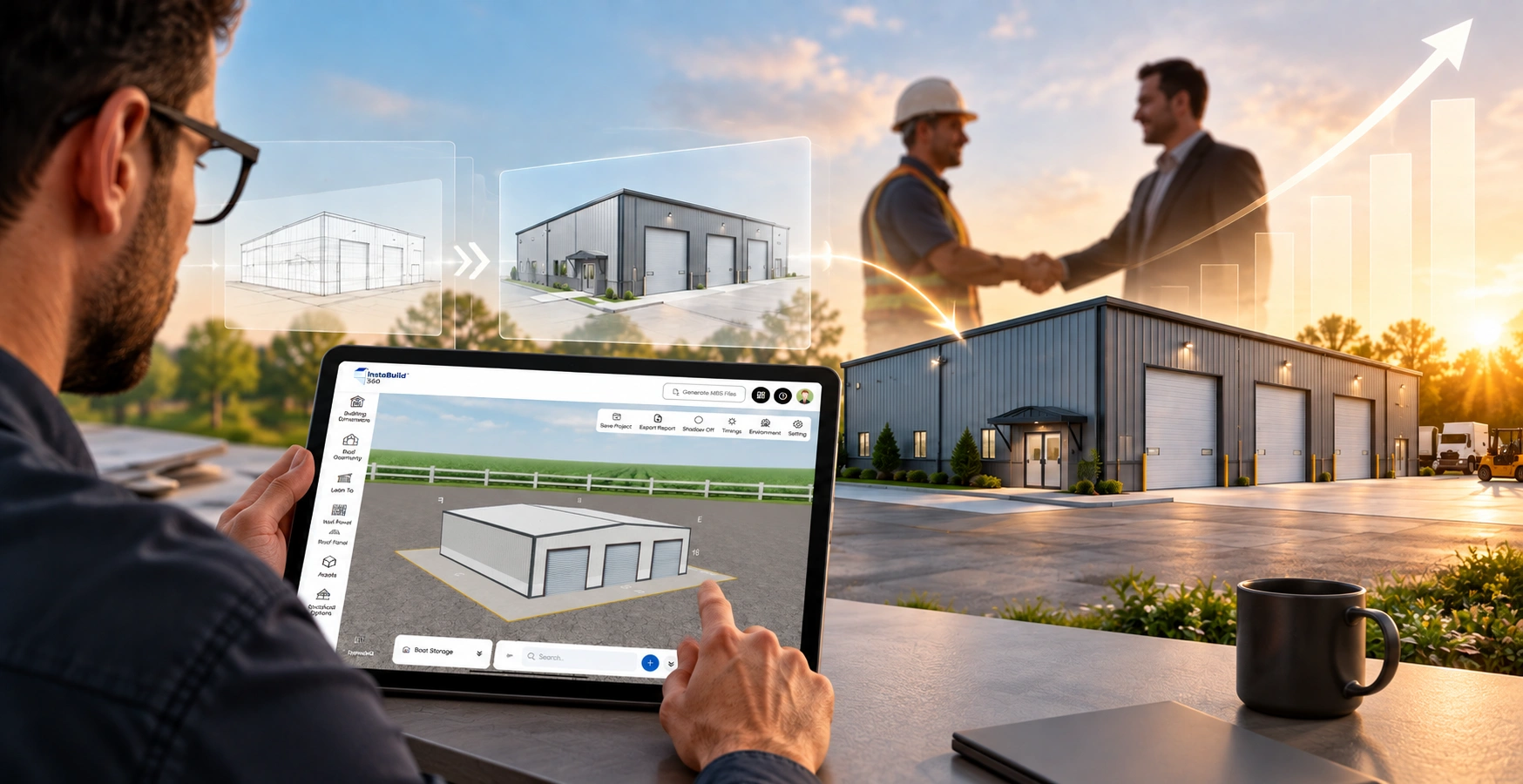
InstaBuild360 captures proposed buildings as engineering-aware, code-compliant 3D models during the initial customer engagement. Buyers can evaluate roof configurations, inspect structural components by adjusting wall and roof visibility, assess terrain and sunlight conditions, and visualize multiple buildings within future expansion scenarios.
Instead of interpreting abstract drawings, buyers evaluate a realistic representation of the proposed solution, significantly improving understanding and reducing decision uncertainty.
Demonstrating Professionalism Before Pricing Is Finalized
Buyer confidence is established during the earliest interactions, not after engineering has completed the final design package.
Professional digital engagement communicates operational maturity long before a quotation is submitted.
It begins with meaningful responsiveness.
Rather than acknowledging receipt of an inquiry with a placeholder’s email, leading manufacturers provide buyers with an initial building configuration based on available project information. Sensible assumptions regarding clear heights, bay spacing, and building openings create an informed starting point for discussion instead of delaying meaningful engagement.
InstaBuild360 enables sales teams to generate these engineering-aware configurations directly within the browser during customer conversations, eliminating delays associated with traditional drafting workflows.
Professionalism also depends upon technical credibility.
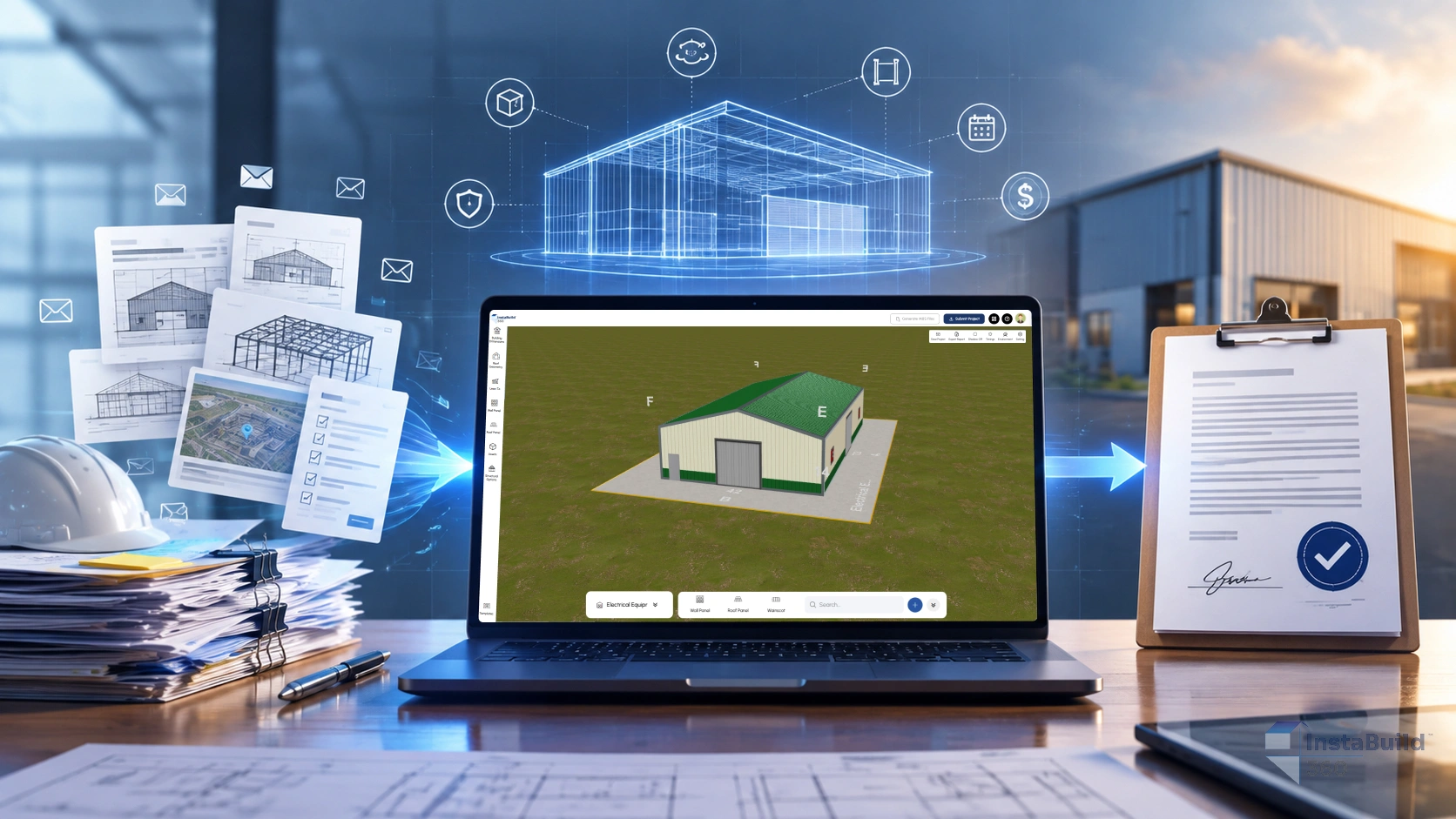
Embedded engineering intelligence validates configuration decisions immediately against structural compatibility and applicable engineering constraints. Whether buyers request mezzanines, revised roof slopes, or additional accessories, the platform confirms technical feasibility in real time while explaining any limitations. Buyers experience a disciplined engineering process rather than speculative sales discussions.
Equally important is early transparency.
Because the configuration model serves as the single source of project information, scope is communicated visually from the outset. Doors, windows, insulation, canopies, liner panels, and other building components are clearly identified within the interactive model. As information progresses into estimating and engineering, the likelihood of scope drift is significantly reduced because data is not recreated across multiple disconnected systems.
Research published in EY’s 2024 Engineering and Construction Analysis indicates that organizations investing in digital front-end engagement reduce bid cycle duration by approximately 30% while improving win rates through earlier alignment of project expectations.
Early alignment changes the basis of competition. Buyers evaluate confidence and execution capability instead of focusing exclusively on price.
Buyer Experience Is Becoming the Primary Competitive Advantage
The competitive landscape for Pre-Engineered Metal Building manufacturers continues to evolve. While product quality, engineering expertise, and pricing remain essential, they are increasingly viewed as baseline expectations rather than sources of differentiation.
The organizations consistently achieving stronger conversion rates are those that remove complexity from the buying process.
They respond while buyer intent remains high. They communicate through transparent, structured proposals rather than static documentation. They enable customers to visualize the proposed building before requesting approval. Most importantly, they maintain information continuity from the initial inquiry through estimating, engineering, fabrication, and project delivery.
Collectively, these capabilities create a buying experience that reduces uncertainty at every stage of the customer journey.
For buyers making significant capital investments, confidence is often more influential than marginal price differences. Suppliers that consistently demonstrate technical credibility, operational maturity, and responsiveness are better positioned to win projects even when competing proposals are similarly priced.
This shift represents a broader transformation within the industry. Competitive advantage increasingly belongs to manufacturers that simplify complex purchasing decisions while enabling buyers to make informed decisions with greater speed and confidence.
Experience a More Competitive Sales Process
Modern manufacturers require more than visualization software.
They require a digital platform capable of connecting sales, estimating, engineering, and project delivery through a single, structured source of information.
InstaBuild360 was developed to support this objective.
By combining AI-assisted configuration, real-time 3D visualization, embedded engineering intelligence, and enterprise-ready integration within a browser-based environment, the platform enables manufacturers to modernize the entire front end of the sales process.
Instead of relying on disconnected workflows and repeated manual data entry, organizations establish a continuous flow of validated project information from the first customer interaction through detailed engineering and fabrication.
The result is a sales process that is faster, more transparent, and better aligned with the expectations of today’s commercial buyers.
For manufacturers evaluating opportunities to improve dealer performance, increase sales conversion, and strengthen competitive positioning, the greatest opportunity often lies not in lowering prices but in improving how buying decisions are supported.