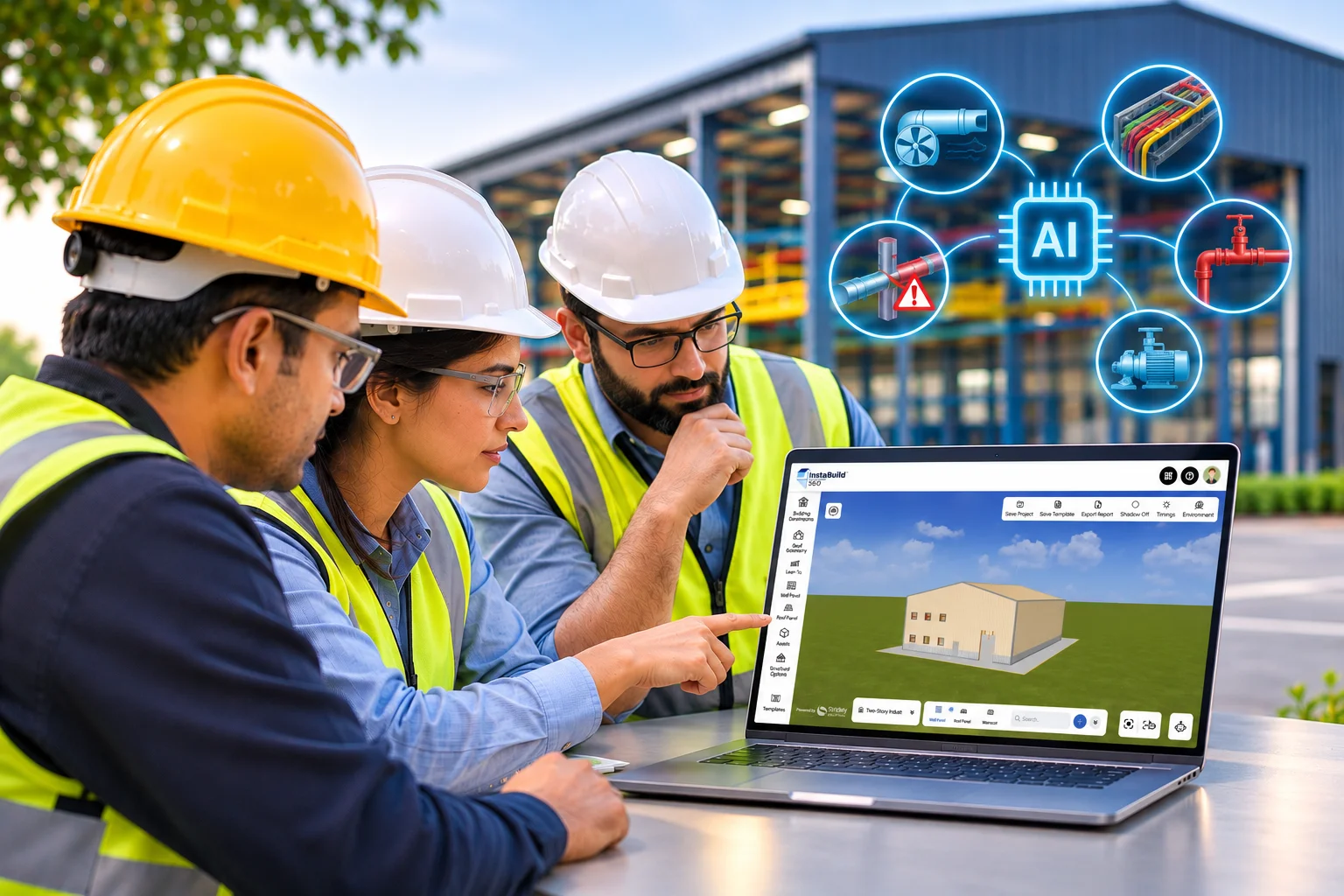
AI is transforming the construction industry and cutting down on waste and streamlining workflow. AI in the construction industry is contributing to the efficiency of the workflows and reducing bottlenecks.
Often construction bottlenecks are not due to lack of manpower, machinery or material resources. They are typically the result of out-of-the-way information collection, processing, sharing, and reacting. When all the required tools are available, operations are slowed down due to manual documentation, disorganized software systems, project data that is not consistent, and decisions that are delayed.
Artificial Intelligence (AI) can be a solution for construction companies to overcome this inefficiency, including through AI engineering automation. By automating tasks that traditionally require extensive paperwork, AI can also help cut down on administrative work, as well as spot potential risks to the project’s schedule and assist in resource management. For busy teams, even small delays can quickly compound across active projects, making it a wholesome problem for the entire project.
Why Construction Processes Develop Bottlenecks
Coordinating various project management, procurement, finance, engineering, site operations, and external stakeholders is critical to construction operations, including workflows that involve PEMB engineering automation. The functions produce information which affects other aspects of the project.
If such functions are implemented in isolated systems, information has to be passed from one system to the other manually.
Typical operational bottlenecks cover:
- Handwritten and verified project information.
- Late submission of requests for information (RFIs), contracts, and change order.
- Some lack insight into schedule risks and resource availability.
- Disconnected procurement, financial and project management information.
- Lack of consistent documentation/reporting.
- Ambiguous responsibility for decisions and follow up.
Clear ownership helps teams resolve issues before they spread across departments quickly, making it smooth for everybody involved.
Automating Document Processing and Communication
There is significant documentation that is created on construction projects, such as specifications, contracts, Requests for Information, inspection reports, submittals and change orders, including documentation handled through metal building engineering software.
This feature can be used for:
- Document classification & information extraction.
- Automated routing to the appropriate department.
- Collation of correspondence from a project.
- Determination of missing data and/or missing submissions.
- Search through approved historical documents of projects.
- Standardized reports and administrative records preparation.
Faster access to reliable information gives staff more time for meaningful review, streamlining things to a great extent.
Predictive Analytics for Schedule and Resource Optimization
Past schedules, past productivity, task dependency, weather data and resource availability can all be fed into machine learning models to help determine patterns that are associated with project risk, supporting AI engineering automation.
These models, supported by reliable data can aid construction companies:
- Find activities that have a higher risk of delay.
- Assess any possible changes to a schedule.
- Make better decisions about the allocation of resources.
- Recognize productivity trends.
- Make support cost estimates and plan projects.
The conditions, contractual relationships, restrictions and decisions which subject construction schedules to changes are not always fully represented in historical data.
Clear business rules are required for resource optimization, too, including when PEMB engineering automation is used to support planning. Even though the allocation of resources on paper is the most efficient, it may not be suitable if that does not meet the safety requirements, contractual requirements or the priority of the project.
Better forecasts matter when teams can act early, confidently, and with accountability taking over it makes a win-win solution for all.
Computer Vision for Progress Monitoring and Safety
Computer vision systems can be used to identify visible changes in site conditions, to compare the work done seen in the images with the work plan, and to highlight potential safety issues depending on the quality of the image, the capability of the computer vision system and deployment conditions, including in workflows supported by automated building design tools.
These functions can help to ensure uniformity in reporting and offer more detail in reviews of projects.
There are several considerations, such as privacy, accessing images, retaining data, and ensuring that the model is accurate, that need to be paid close attention during implementation. Results may vary due to the lighting, camera positioning, objects, and changes in site conditions. Visual observations should therefore be corroborated before it is considered as part of data for making consequential decisions.
Computer vision can best be used alongside existing inspection procedures and reports – it does not need to be a source of truth.
Reliable visual evidence supports better conversations, but context still matters on site.
Also Read: AI for PEMB Manufacturers: Faster Quotes & 3D Design
Integrating AI With Existing Construction Systems
When AI tools are not integrated into the project, financial, procurement and documentation software applications, including metal building engineering software, the insights they provide are of little value to the operation.
A typical architecture for a system using AI consists of:
- Data pipelines: Collect and manipulate data from trusted data sources.
- Classifier/predictor: Generate a summary or categorize data or explain visual information using an AI model.
- Authorized actions: Actions that a user can perform.
- Integration layer: The layer to connect the AI functions with systems, including those used for PEMB design automation.
- Governance layer: Decision making could be tracked in addition to performance tracking other than access controls implementation.
Data sensitivity, technical capabilities, cost and compliance considerations are things that help in deciding whether there should be hosted, self-hosted, or hybrid deployment, including AI engineering automation solutions.
The design of integration should revolve on top of the existing business processes. If adding another application that isn’t connected, it could make administration more complex.
Connected systems work best when teams understand responsibilities, approvals, and next steps.
Data Quality, Governance, and Security
Flawed systems can be caused by incomplete records, and inconsistent terms, schedules, and documents, which can also affect PEMB engineering automation processes.
Prior to deploying AI, construction companies need to define the data terms, standardize key data elements, audit and verify data quality of historical data, and establish ownership for keeping data quality.
There are policies that must be put in place for organizations:
- Who is allowed to have access to information about the project and to the results of the AI.
- What steps must people take to approve the decisions?
- How mistakes made by AI can be detected and rectified.
- How the performance of the model is monitored and how data quality is monitored.
- The level of sensitivity in which information is stored, communicated, and kept.
- How actions and system operations are logged to perform audits.
Role based access control, encryption, good credential management and protection from malicious inputs are all aspects of security. Similarly, AI systems that access internal documents must also be protected from unauthorized access to the information and erroneous answers produced by the AI.
For decisions that have a high impact; especially about safety, contracts, financial obligations, and schedules; human oversight is important.
Trust grows when staff know how data is protected, checked, and used, making it all secure to everybody present in the loop.
Also Read: 3D Building Design Platform: Improve Customer Experience
Where Building Visualization Fits into the Broader Workflow
One other aspect where digital tools can be helpful in minimizing friction for pre-engineered metal building (PEMB) manufacturers is when they are in the early stages of the communication process, including workflows involving PEMB design automation.
Effective understanding of building requirements is necessary to allow for detailed engineering, coordination and subsequent project activities to be effective, particularly when using metal building engineering software. Visual communication can help to build consensus amongst stakeholders about a proposed building and facilitate the discussion of design intent with efficiency.
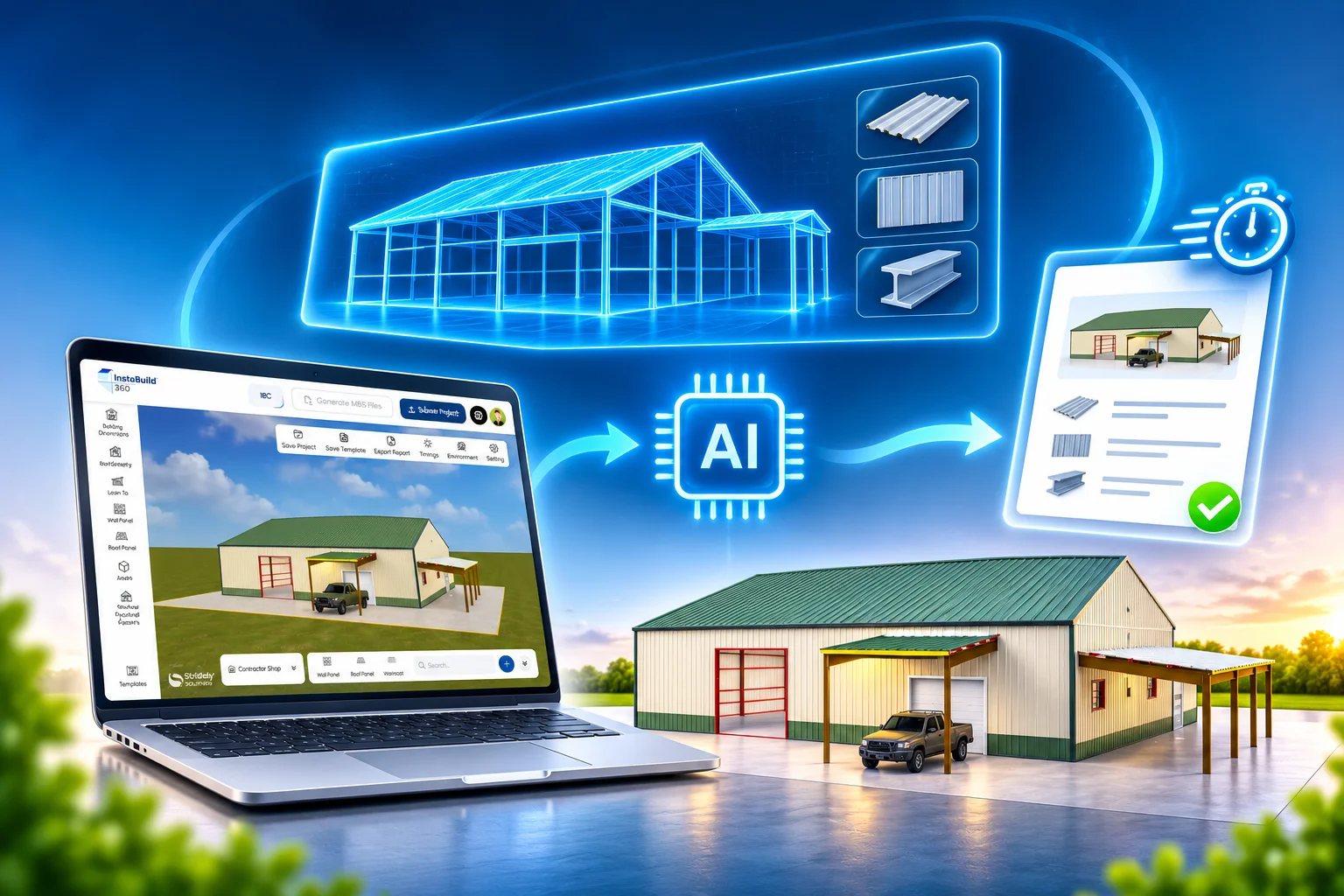
At this stage, InstaBuild360 acts as a guide for AI guidance and 3D visualization, creating an interactive and engaging experience, getting immersed in building and expressing intentions for design decisions.
It has a targeted function: To enhance the visualization and communication of buildings at the early stages. Note that it is different from ERP integration, construction scheduling, and structural engineering automation.
Capturing the information in a clear manner, as part of a wider digital workflow, can support and enhance the project information management system and professionals handling technical validation.
A shared visual reference makes early discussions clearer without replacing technical expertise.
Conclusion
The construction industry has several benefits to gain from AI, such as optimizing document management, aiding in predictive planning, visual data analysis, and integrating operational processes.AI can offer several advantages to construction companies, including document handling optimization, predictive planning, visual data analysis, and operational process integration, including through automated building design and related digital tools.
The first step should be for construction companies to determine the most problematic areas in their information processing, choose the most appropriate and easiest to use technology and compare the results to certain criteria, including the instrumental and potential role of PEMB design automation.
It’s not about the use of AI in all areas of construction. It’s about more reliable processes that deliver information to the right people, decisions on sound data and technology that can mitigate operational friction but still maintain adequate human control. Progress comes from solving the right problems, not chasing every new technology.