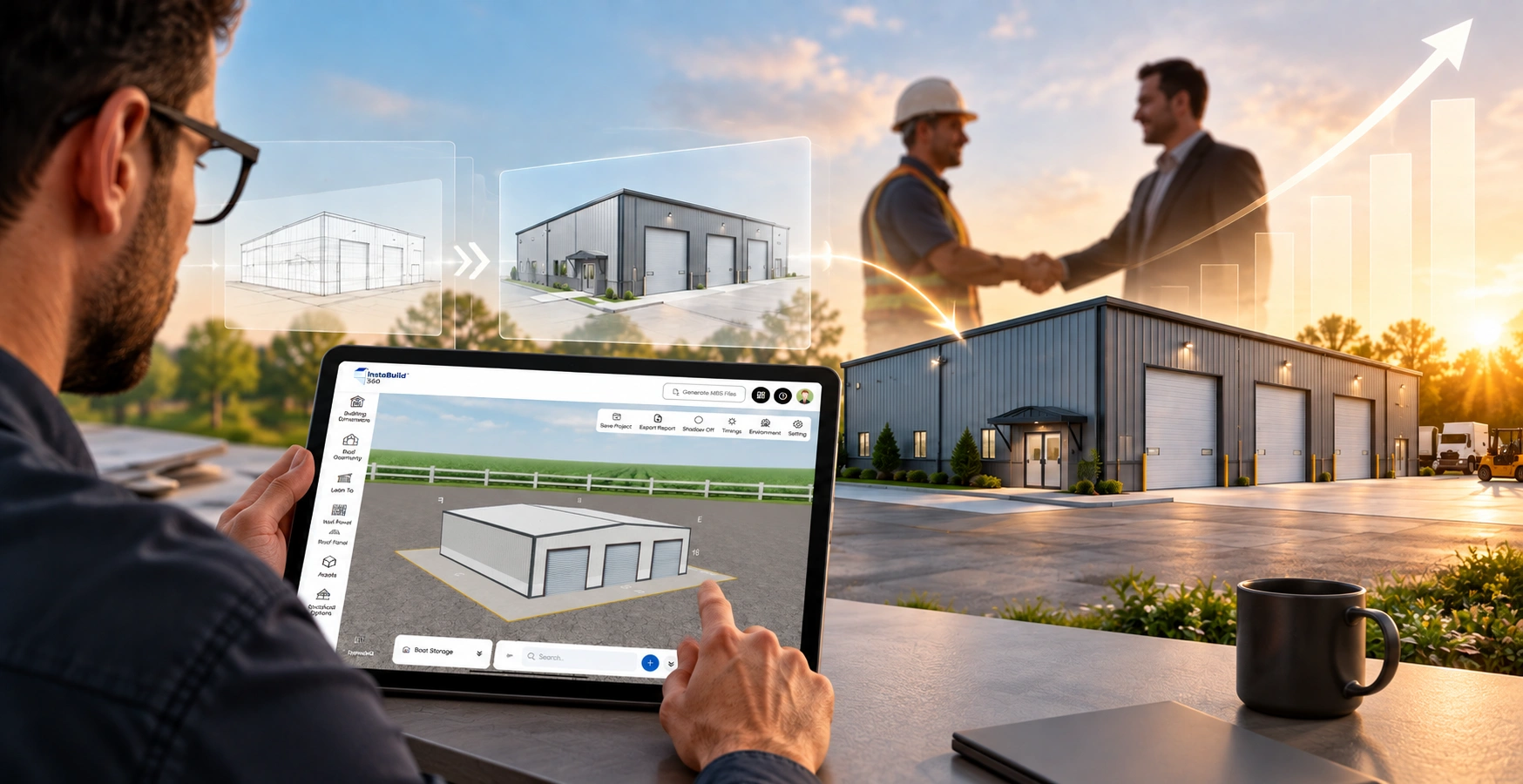
Metal building manufacturers rarely struggle to generate RFQs. The greater challenge lies in converting those opportunities into signed contracts.
For many PEMB manufacturers, the pattern is familiar. An RFQ enters the pipeline, followed by days of clarifying clear heights, bay spacing, door locations, and structural requirements. By the time a technically complete proposal is ready, the buyer has often selected another supplier. In most cases, the lost opportunity is not driven by price. It is the result of delays between receiving the RFQ and presenting a proposal that is technically credible, visually compelling, and easy to approve.
InstaBuild360 was developed to reduce this critical interval. By replacing static 2D intake processes with structured, interactive, and engineering-aware building configurations, the platform enables manufacturers to move efficiently from initial inquiry to accurate quotation.
Key Takeaways
- Why RFQs lose momentum when requirements are incomplete and visualization is absent.
- How buyers evaluate proposals using multiple criteria beyond price alone.
- Why live 3D configuration improves RFQ quality at the earliest stage.
- How embedded engineering validation accelerates early design iterations.
- Why structured configuration data enables faster pricing, greater transparency, and stronger buyer confidence.
Why Promising RFQs Fail to Progress
At first glance, a typical PEMB RFQ appears straightforward. It may include dimensions, opening locations, and a project address. In reality, every RFQ contains numerous assumptions that significantly influence the final proposal.
Does the specified clear height refer to the bottom of the structural steel or the insulation system? Should the overhead door be positioned within the endwall or sidewall? Has the owner already anticipated future expansion, such as a lean-to, without explicitly documenting it?
Traditional intake processes rely heavily on email exchanges, phone conversations, and manually recorded notes. Information is subsequently recreated within CAD systems, estimating software, and proposal documents. Every transfer introduces opportunities for inconsistency, omission, or misinterpretation.
Increasing project volume amplifies these challenges. According to the U.S. Census Bureau, total U.S. construction spending exceeded $2.1 trillion at a seasonally adjusted annual rate during early 2025. As inquiry volumes continue to rise, estimators are required to process more RFQs within the same timeframe. When intake remains manual, information quality declines, clarification cycles increase, and response times become more difficult to sustain.
What RFQ Evaluators Actually Assess
Successful RFQ responses are evaluated on substantially more than price alone.
Decision-makers typically assess proposals across five key dimensions.
Qualifications and Experience. Buyers want evidence that the manufacturer has successfully delivered comparable projects. Demonstrating relevant experience visually is considerably more persuasive than describing it generically.
Technical Approach. Evaluators look for proposals that demonstrate a clear understanding of structural requirements, including clear heights, roof geometry, building openings, and site-specific considerations. Generic responses rarely inspire confidence.
Pricing Transparency. Competitive pricing remains important, but equally important is the ability to explain how that price is constructed. Itemized, transparent proposals provide buyers with greater confidence than undifferentiated lump-sum quotations.
Schedule Confidence. Buyers evaluate whether manufacturers can realistically achieve production and erection timelines given current workloads, resource availability, and project complexity.
Safety and Compliance. Current certifications, clearly defined safety procedures, and demonstrated regulatory compliance reinforce confidence that the project can be delivered without unnecessary risk.
Industry conditions further increase the importance of schedule credibility. The Associated General Contractors of America reports that 91% of contractors continue to experience workforce shortages, directly affecting schedule reliability across construction projects. Buyers understand these constraints and are more likely to select suppliers that present realistic delivery commitments supported by credible planning rather than optimistic promises.
How Poor RFQ Intake Reduces Sales Conversion
When an RFQ enters the sales process as a collection of forms, attachments, and disconnected communications, several challenges emerge simultaneously.
Buyers struggle to interpret static 2D drawings. Sales and engineering teams spend days exchanging clarification emails. Identical project information is repeatedly recreated across CRM, estimating, and engineering systems.
Each additional clarification cycle extends the sales process and weakens buyer momentum. While one supplier continues resolving administrative questions, another may already be presenting an interactive building model and discussing project specifics in real time.
CBRE’s 2024 U.S. Construction Cost Analysis identifies information gaps and project rework among the primary contributors to cost overruns within industrial construction. Within the PEMB sales process, those inefficiencies begin well before fabrication—they originate during RFQ intake.
Improving RFQ Quality at the Source
Leading manufacturers improve conversion by addressing RFQ quality before downstream processes begin.
Rather than correcting incomplete information after an RFQ has entered the pipeline, InstaBuild360 enables manufacturers to capture buyer requirements as structured, engineering-aware building configurations from the outset.
Delivered through a browser-based environment requiring no software installation, the platform allows sales teams to modify dimensions, roof configurations, clear heights, and accessories during live customer conversations. Embedded engineering rules validate design decisions immediately, eliminating the delays traditionally associated with preliminary engineering review.
Instead of reviewing static forms, buyers interact with a realistic building model. Instead of relying on handwritten notes, sales teams capture a structured digital configuration that remains consistent throughout estimating, engineering, and project delivery.
Why Visualization Strengthens Competitive Positioning
A high-quality 3D model delivers significantly more than an improved presentation. It enables buyers to evaluate the proposed solution with greater confidence by answering many of the practical questions that influence purchasing decisions before they need to be asked.
Static drawings communicate dimensions, but they do not effectively illustrate how a building will relate to its surrounding environment or support day-to-day operations. Buyers are left to interpret trim details, wall panels, roof geometry, access points, circulation space, and future expansion based on technical documentation alone.
Interactive visualization removes that uncertainty.
InstaBuild360 enables buyers to evaluate proposed buildings within realistic operating conditions by simulating terrain, sunlight, spacing, and surrounding site constraints. Architectural and structural elements—including wall panels, trim colors, doors, windows, louvers, canopies, bracing, and ventilation systems—are presented within the context of the complete project rather than as isolated specifications.
The platform also supports multi-building configurations, allowing manufacturers to demonstrate future expansion phases without recreating the project from the beginning.
This capability transforms how proposals are evaluated.
Instead of relying on broad statements such as “We have experience delivering similar projects,” manufacturers can demonstrate comparable facilities that reflect similar scope, complexity, and operational requirements. Technical narratives become supported by realistic visual evidence rather than descriptive language alone.
Research from FMI Corporation reinforces the commercial value of this approach, identifying inadequate preconstruction planning and limited visual alignment as significant contributors to margin erosion across specialty construction projects. Establishing visual clarity during the RFQ stage not only strengthens buyer confidence but also reduces downstream uncertainty that can affect project profitability.
Within InstaBuild360, visualization is not created as a post-design marketing asset. It is generated directly from the engineering-aware configuration model, ensuring that buyers evaluate a representation closely aligned with the building that will ultimately be fabricated and delivered.
Also Read: AI in Pre-Engineered Metal Building Design: Faster Quotes & 3D Visualization
Reducing Clarification Cycles Through Conversational AI Guidance
Many building owners and project stakeholders possess extensive operational expertise without being familiar with the technical terminology commonly used within the PEMB industry.
Concepts such as bay spacing, eave struts, purlin laps, or structural framing requirements can unintentionally create friction during early project discussions. Buyers often understand their operational objectives but may struggle to translate those objectives into engineering terminology.
InstaBuild360 addresses this challenge through conversational AI guidance that supports buyers throughout the configuration process using straightforward, business-focused language.
When critical dimensions such as height, width, or building length have not yet been defined, the platform generates an appropriate baseline configuration that can be refined collaboratively. If a requested size or configuration is unavailable, the system recommends the nearest technically feasible alternative while explaining the engineering rationale behind the recommendation.
Architectural selections—including wall panels, colors, doors, windows, and additional accessories—can likewise be configured without requiring buyers to navigate complex product catalogs or engineering documentation.
This guided approach produces measurable operational benefits.
Because requirements are clarified during the initial customer interaction, engineering teams receive more complete and technically consistent project information. Clarification emails decrease, assumptions are reduced, and preliminary design reviews become substantially more efficient.
The result is a cleaner, more reliable RFQ before it reaches downstream engineering and estimating workflows.
Turning Buyer Intent into a Faster Sales-to-Quote Process
Every customer interaction generates valuable information. The organizations that convert more opportunities are typically those that capture, preserve, and apply that information without introducing unnecessary manual processes.
InstaBuild360 transforms customer-driven building configurations into structured datasets that flow directly into CRM and estimating systems without manual re-entry. Configuration details, project dimensions, selected components, and site-specific considerations remain connected throughout the sales process, enabling manufacturers to respond while buyer intent remains strongest.
This continuity also improves pricing quality.
Because estimating data originates from the same engineering-aware configuration used during customer engagement, pricing remains closely aligned with the proposed design. Buyers receive transparent, itemized quotations that clearly distinguish construction scope, general conditions, contingency allowances, professional fees, and optional value engineering alternatives.
Rather than presenting pricing as a single aggregated figure, manufacturers can demonstrate precisely how design decisions influence overall project investment.
This level of transparency strengthens buyer confidence while reducing the likelihood of misunderstandings later in the project lifecycle.
Industry research further highlights the importance of information quality. According to KPMG’s Global Construction Survey, 69% of project owners identify poor contractor performance in managing project information as a contributing factor to project underperformance.
For many buyers, the RFQ response represents the first meaningful indication of how effectively a manufacturer will manage project information after contract award. Organizations that present structured, transparent, and well-coordinated proposals establish credibility long before construction begins.
From RFQ Friction to Signed Contracts
Converting more RFQs into signed contracts requires more than well-written proposals or persuasive cover letters. Sustainable improvements in conversion begin much earlier—at the point where project requirements are first captured.
When buyer requirements are documented through fragmented conversations, manually transferred between systems, and repeatedly clarified throughout the sales process, uncertainty increases while buyer momentum declines. Every additional handoff introduces opportunities for inconsistency, extends response times, and weakens confidence in the proposed solution.
Leading PEMB manufacturers take a different approach.
They establish information quality at the earliest stage of engagement by capturing buyer requirements as structured, engineering-aware building configurations. As that information progresses seamlessly through estimating, engineering, and proposal generation, buyers receive faster responses, greater pricing transparency, and increased confidence that the proposed solution accurately reflects their operational requirements.
Interactive visualization further strengthens this experience. Buyers are able to evaluate the proposed building before pricing is finalized, engineering rules validate design decisions in real time, and configuration data flows directly into downstream business systems without manual re-entry.
Collectively, these capabilities transform the RFQ process from an administrative exercise into a competitive advantage.
Organizations that consistently reduce buyer uncertainty, accelerate proposal readiness, and maintain information integrity throughout the sales process are better positioned to improve conversion rates and secure more contracts without relying solely on pricing concessions.
Experience a More Effective RFQ-to-Contract Process
InstaBuild360 enables PEMB manufacturers to modernize the earliest stages of the sales cycle through AI-assisted configuration, real-time 3D visualization, embedded engineering intelligence, and integrated enterprise workflows.
By improving information quality at the point of intake and maintaining continuity throughout estimating and engineering, manufacturers can respond faster, present proposals with greater confidence, and improve overall sales conversion.