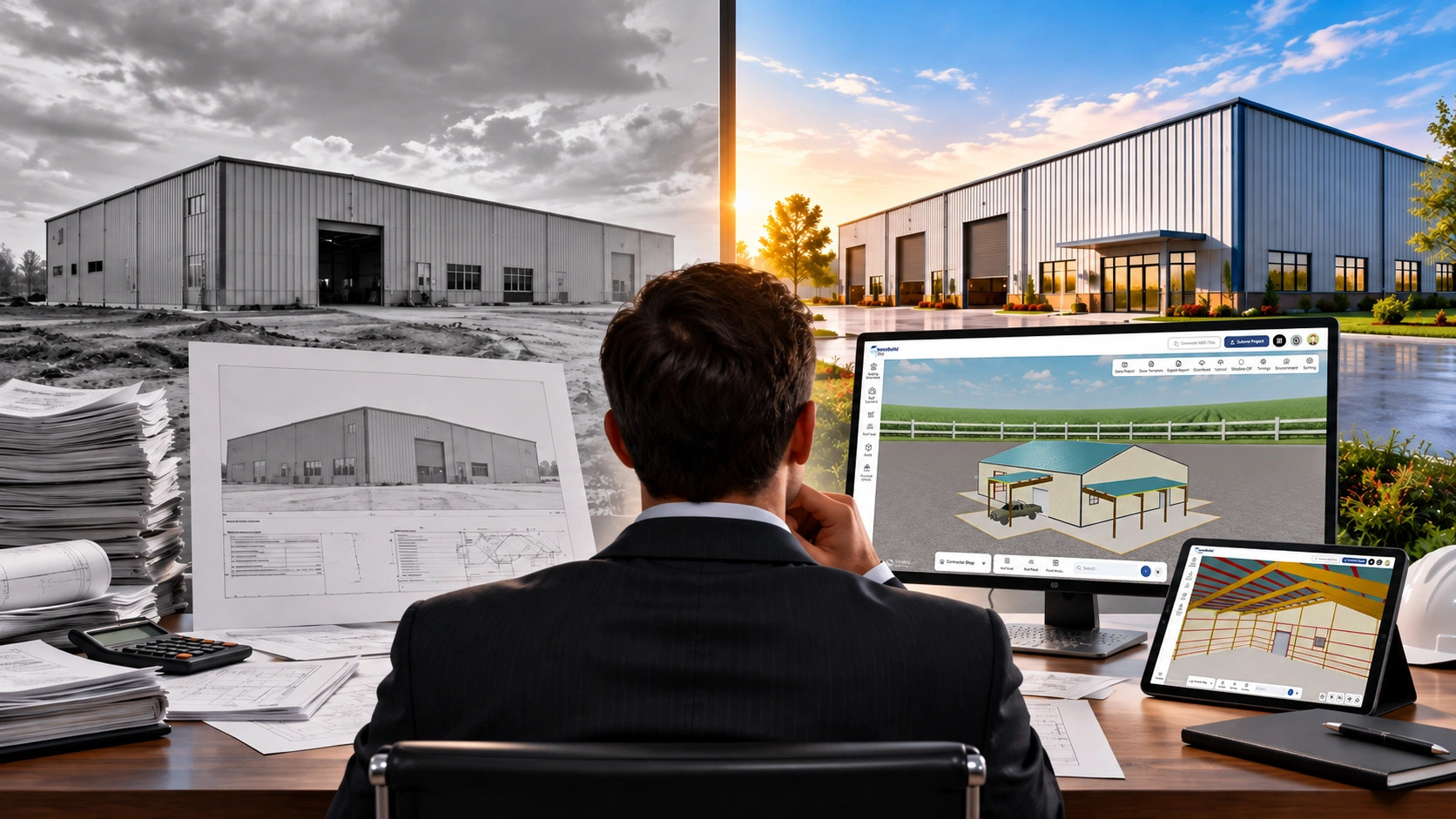
Metal building manufacturers rarely lose opportunities because a project cannot be engineered or constructed. More often, opportunities are lost within the first 48 hours after an inquiry—when buyers struggle to visualize the proposed building, sales teams are waiting for drafting support, and quotations arrive after initial buying momentum has diminished.
Across the industry, dealers consistently encounter the same pattern. Buyers typically request multiple quotations, yet the supplier that communicates the proposed solution with the greatest clarity often secures the business, even when its pricing is not the lowest. As a result, sales conversion is rarely constrained by price alone. It is primarily influenced by the speed and clarity of the buying experience.
InstaBuild360 addresses these challenges by replacing static 2D drawings with real-time interactive 3D configuration, conversational AI guidance, and embedded engineering intelligence. The result is a faster transition from initial inquiry to an accurately priced, buildable project.
Key Takeaways
- Sales conversion declines when buyers cannot confidently interpret static 2D proposals and approvals are delayed by drafting workflows.
- Live configuration during customer engagements eliminates unnecessary iterations and preserves buyer momentum.
- Embedded engineering validation removes early-stage technical bottlenecks that frequently delay opportunities.
- Immersive 3D visualization within realistic site environments strengthens buyer confidence and accelerates decision-making.
- Structured, intent-rich configuration data integrates directly with CRM and estimation workflows, enabling faster and more accurate pricing.
Why Sales Conversion Suffers During the Early Buying Stage
Many manufacturing organizations continue to rely on fragmented workflows during the earliest stages of the sales process. Customer requirements are captured through emails or phone conversations, interpreted into CAD models, transferred into estimating spreadsheets, and ultimately reformatted into proposal documents. Within this workflow, sales teams spend much of their time coordinating information between buyers and engineering rather than actively configuring solutions with customers.
From the buyer’s perspective, these disconnected processes create unnecessary delays. They are unable to visualize architectural details such as trim, liner panels, openings, or the building’s placement within the intended site. Each clarification introduces additional waiting time, reducing confidence and slowing purchasing decisions.
Industry research highlights the growing importance of responsiveness. HubSpot reports that 78% of B2B customers purchase from the company that responds first, while 60% believe they wait longer than expected for a response. For high-value construction projects, delayed engagement directly impacts conversion performance.
What Is a 3D Engineering Platform Designed for Sales Conversion?
A 3D engineering platform designed for sales conversion enables manufacturers, dealers, and contractors to configure, visualize, and validate building concepts in real time through a browser-based environment, eliminating the need for software installations or plugins.
Purpose-built for pre-engineered metal buildings and post-frame structures, InstaBuild360 combines real-time 3D visualization, a comprehensive library of steel, concrete, and structural components, conversational AI assistance, environmental and site visualization, multi-structure project management, enterprise integration capabilities, and SOC 2 Type I compliance within a single platform.
The market opportunity further underscores the importance of improving conversion performance. According to Mordor Intelligence, the global pre-engineered building market is projected to grow from USD 26.32 billion in 2025 to USD 43.84 billion by 2030, representing a compound annual growth rate (CAGR) of 10.72%. As inquiry volumes continue to increase, conversion efficiency will play an increasingly important role in determining revenue growth.
How Live Configuration Preserves Buyer Momentum and Reduces Drop-Off
Live configuration fundamentally changes the sales conversation. Instead of telling buyers that an updated drawing will be provided later, sales teams can demonstrate design changes immediately during the discussion.
Dimensions, roof configurations, clear heights, bay spacing, and accessories—including walk doors, windows, louvers, and canopies—can be modified in real time while buyers observe the impact instantly through the interactive model. This eliminates drafting queues and removes the delays associated with revised proposal documents.
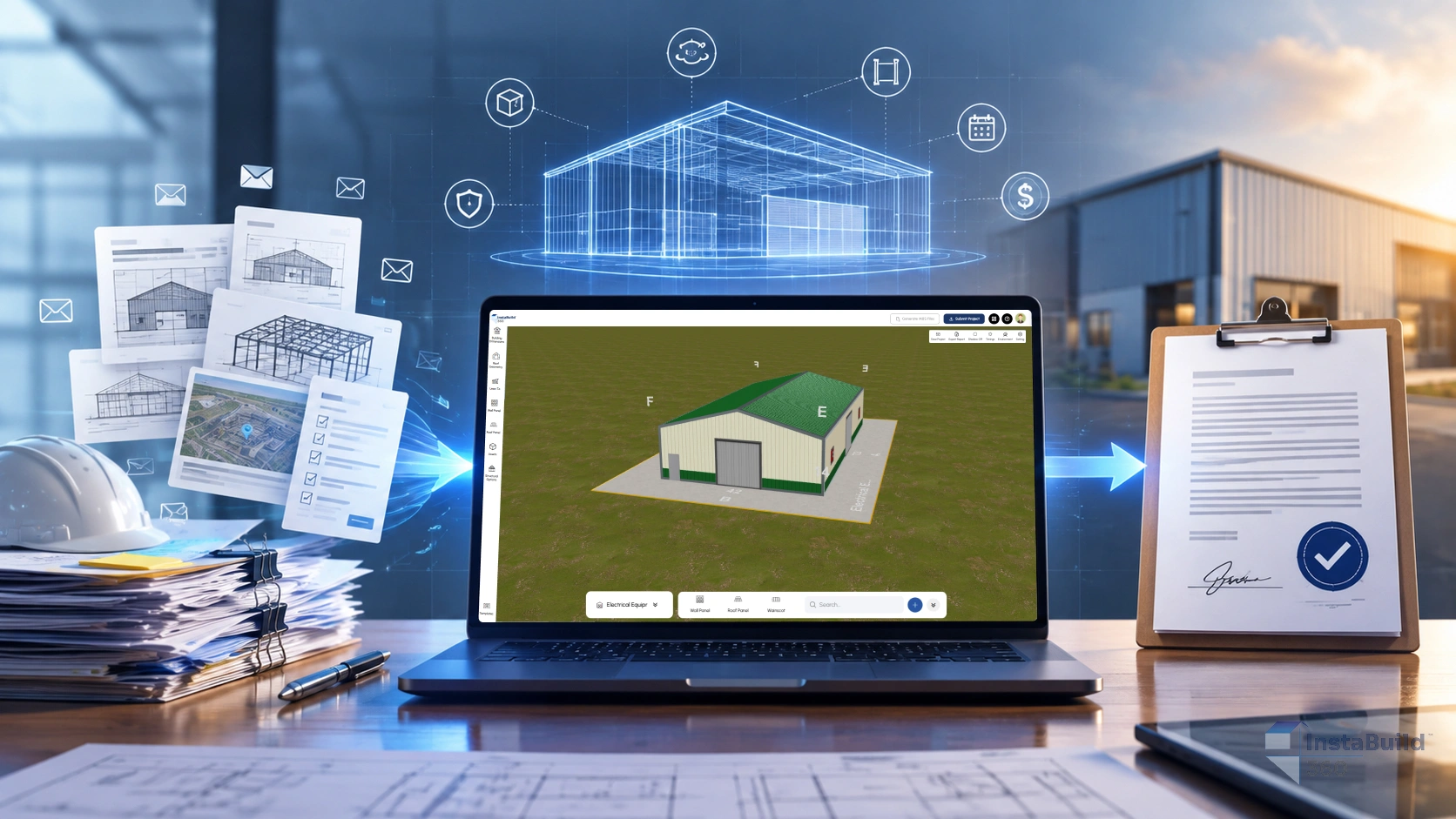
Equally important, completed configurations do not require manual recreation across downstream systems. Configuration data flows directly into CRM and estimation workflows as structured information. Consequently, the design presented by sales becomes the same design used for pricing and engineering, minimizing information loss and reducing the clarification cycles that frequently delay quotations.
Also Read: https://instabuild360.com/how-to-turn-more-rfqs-into-signed-metal-building-contracts/
How Instant Feasibility Validation Removes the Engineering Bottleneck
In many sales processes, early-stage configurations are delayed while engineering teams verify whether proposed dimensions, bay spacing, crane loads, or accessory combinations are feasible. Although these checks are essential, they frequently become a bottleneck that slows buyer engagement and extends the sales cycle.
InstaBuild360 addresses this challenge by embedding engineering rules and design constraints directly into the configuration workflow. Proposed building configurations are validated in real time against predefined feasibility logic, ensuring that only buildable combinations progress through the sales process.
This approach delivers two important business outcomes. First, sales teams can engage buyers with greater confidence because they are presenting technically viable solutions. Second, engineering resources can focus on detailed design and optimization rather than repeatedly reviewing preliminary concepts that may never proceed.
The financial impact of early validation is significant. Autodesk Construction Cloud reports that rework associated with design errors and coordination conflicts can account for up to 5% of total project costs, with some projects experiencing substantially higher levels of rework. Identifying non-buildable options during the configuration stage helps protect both project margins and delivery schedules.
How Immersive Visualization Strengthens Buyer Confidence and Accelerates Approval
Buyers approve projects more quickly when they clearly understand what they are purchasing. Static line drawings require interpretation and technical literacy; immersive 3D visualization reduces that cognitive burden.
InstaBuild360 enables buyers to interact with a realistic digital representation of the proposed building within its intended site context. Clients can rotate the model, inspect structural elements by toggling wall and roof visibility, reposition openings, evaluate sunlight and terrain conditions, and review multi-building layouts for future expansion phases. Architectural details such as trim colors, wall panels, and operational areas are presented in a realistic environment rather than as abstract symbols.
Industry data supports the commercial value of this approach. Research on product visualization indicates that organizations offering 3D and augmented reality experiences achieve 40% higher conversion rates and 25% fewer returns compared with static imagery. When buyers can confidently visualize the final outcome, approvals tend to occur faster and with fewer clarification requests.
For capital projects such as metal buildings, immersive visualization does more than improve presentation quality—it reduces perceived risk and increases decision confidence.
How Conversational AI and Intent-Rich Data Convert Inquiries into Priced Projects
Prospective buyers often enter the sales process with incomplete information. They may know the intended use of the building but not the exact width, length, height, or accessory requirements. Traditional workflows force these buyers into a technical discovery process that can quickly become frustrating.
InstaBuild360 simplifies this interaction through conversational AI guidance. The platform can generate an appropriate baseline configuration when key dimensions are missing, support modifications to wall panels, colors, roof configurations, visibility settings, and accessories, and intelligently recommend the closest feasible alternative when a requested size is unavailable while explaining the rationale for the recommendation.
The value of this interaction extends beyond buyer guidance. Every configuration action generates structured, intent-rich data that captures dimensions, selected options, site context, and behavioral signals. This information flows directly into CRM and estimation workflows, enabling immediate pricing, automated proposal summaries, and higher-quality sales pipelines.
Follow-up effectiveness is another critical factor in conversion performance. Spotio reports that 44% of sales professionals stop after a single follow-up attempt, while 80% of sales opportunities require five follow-ups before closing. By providing interactive 3D links, itemized configuration summaries, and context-rich proposal data, InstaBuild360 enables sales teams to conduct meaningful follow-up conversations rather than sending generic reminders.
The result is a sales process that remains informative, relevant, and momentum-driven throughout the buyer journey.
Final Words: Achieving Higher Sales Conversion from Existing Demand
For most metal building manufacturers, the primary challenge is not generating additional inquiries. Sales teams already attract a consistent flow of prospects. The greater opportunity lies in improving the percentage of those inquiries that progress from initial engagement to validated quotations and ultimately to signed orders.
Conversion rates decline when buyers struggle to visualize the proposed building, wait days for design revisions, or receive proposals that provide limited visibility into scope and value. Even competitively priced solutions can lose momentum when the buying experience introduces unnecessary uncertainty.
Conversely, when buyers can interact with a real-time 3D model, collaborate on design changes during the sales conversation, receive immediate engineering-aware validation, and review structured, itemized pricing while purchase intent remains high, decision-making becomes significantly more efficient. The same volume of inquiries can therefore generate a greater number of successful conversions.
InstaBuild360 was developed to address this critical stage of the sales journey. By combining AI-assisted guidance, real-time 3D visualization, and embedded engineering intelligence within a browser-based platform, it enables manufacturers to transform early buyer interest into accurately configured, build-ready, and commercially viable projects.
For manufacturers seeking sustainable revenue growth, the objective is not necessarily to generate more leads. It is to convert a greater proportion of existing opportunities into profitable orders through a faster, more transparent, and confidence-driven buying experience.
Ready to Accelerate Your Metal Building Sales? Discover how live 3D configuration and instant feasibility validation remove engineering friction and boost your sales conversion.
Frequently Asked Questions (FAQs)
How can metal building manufacturers improve sales conversion rates?
Manufacturers can improve conversion rates by reducing uncertainty during the buying process. Real-time 3D configuration, embedded engineering validation, conversational AI guidance, and seamless integration with CRM and estimation systems enable buyers to make informed decisions more quickly while allowing sales teams to respond with greater speed and accuracy.