A customer is planning to buy a 30,000 square foot warehouse. The necessary requirements are in place, such as room for expansion, access to trucks, and storage space, but the customer can’t describe what the roof profile, building layout, or entrance placement should look like.
The sales team knows what’s asked for but stating the request in emails and initial sketches can result in misunderstanding of the building. There may be another series of questions (and/or revisions) at the end of the customer’s proposal.
This is where the role of AI-driven tools and 3D building visualization can be beneficial for AI for pre-engineered metal building (PEMB) manufacturers, but it’s not to replace engineering, rather, it’s to help with clarity in early conversations through AI in PEMB and AI-powered metal building design.
Why AI Matters for PEMB Manufacturers in 2026
The constraints are increasing with construction firms. Customers demand more customization and shorter response times, and manufacturers must deal with material prices, labor availability, and, even more, they expect a growing level of customization through PEMB automation and metal building automation.
The 2026 Construction Hiring and Business Outlook from Associated General Contractors of America (AGC) and Sage discovered that 61 percent of the construction firms surveyed said they were using the technology or intended to increase investments, a rise from 44 percent last year. In the meantime, 57% said that they lacked workers or subcontractors, and 53% said material costs are a problem.
The results are not from manufacturers of PEMB, but from the US construction industry as a whole and show the need for businesses to look for viable options to enhance productivity and communication, particularly for AI for metal building manufacturers.
India’s market is also interesting. The pre-engineered metal building market in India is expected to grow at a CAGR of 9.7% during 2021–2033 and is projected to hit US$3.71 billion this year. This is an estimate of the number of market research and not the official estimate from the Government.
As the demand and expectations of customers change, it is an important task to clearly communicate a building concept as part of the sales process, making AI for PEMB manufacturers an important area to explore.
The Real Problem: Customers Can’t Always Picture the Building
The customer may, for example, want a warehouse that has a specific roof shape, a larger entrance, or more loading space. The above requirements appear simple, but it is important to note that they are not always easily conveyed in writing as to how the final structure will appear.
This is a real-world problem accompanied by an example of why AI-powered metal building design and visualization can support clearer communication.
Suppose this manufacturer is talking to a potential customer about a warehouse. The first concept is a standard roof with doors on one side. The customer then sees the plan, and realizes the entrance needs to be towards the access road, and the roofline needs to be different.
Now, the team has to come back to the idea and validate the new requirement.
This is an example and not a real case scenario of a customer. It illustrates the potential for miscommunication to be caused by vague expectations.
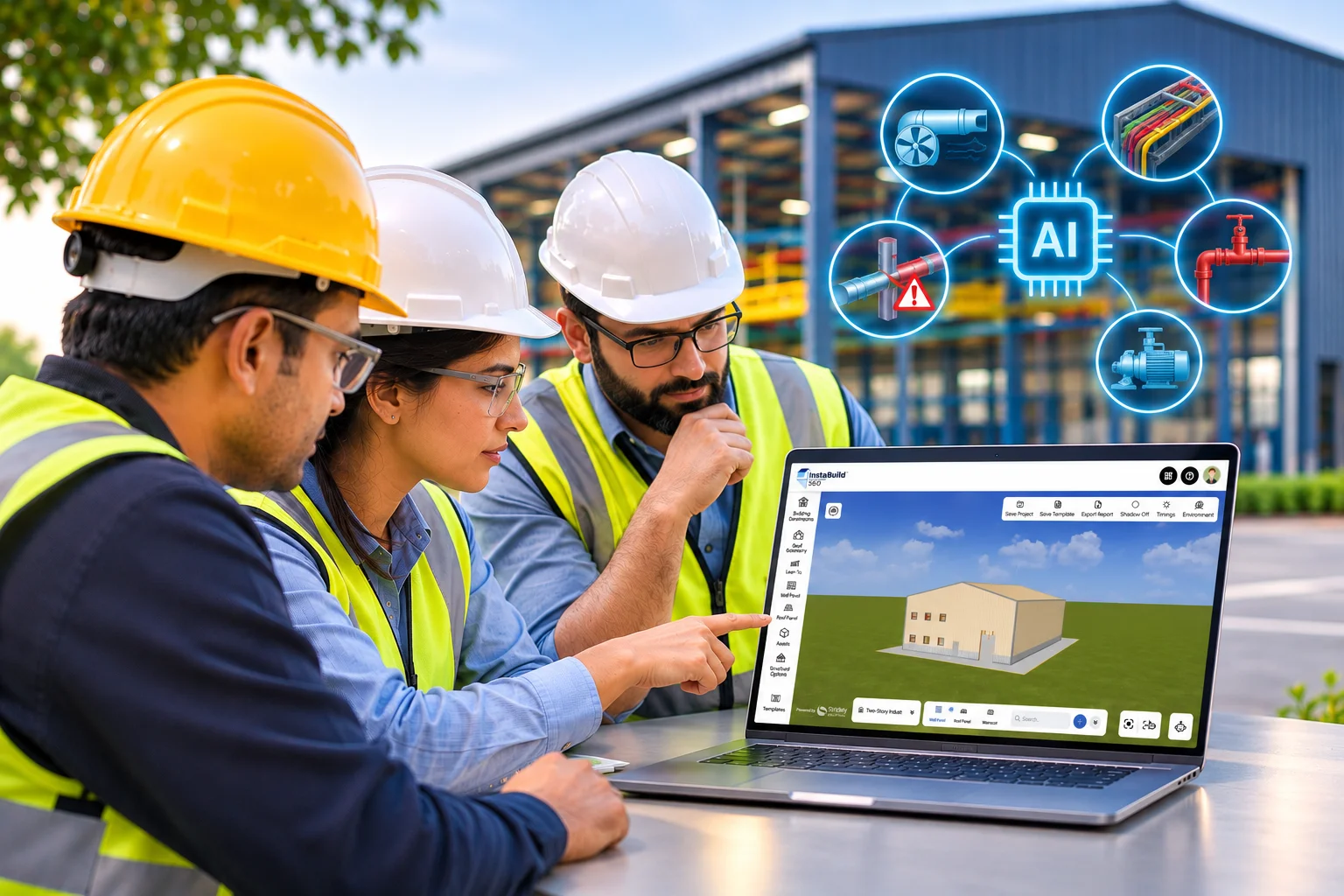
A 3D building visualizer provides a more real-life reference for both, supporting AI in PEMB. They do not have to memorize and use technical descriptions but can discuss the concept of the building that is visible along with questions to address.
What AI and 3D Visualization Can Actually Improve
1. Make early customer discussions more productive
Visual representation enables customers to communicate with us about what they like or dislike, even though they have no technical knowledge. It can be used by the sales team to talk about the exterior of the building, the overall layout, and visible elements, prior to finalizing requirements, which is useful for AI for metal building manufacturers.
This is not to say that it removes all revisions. It assists in rendering communication more smoothly.
2. Identify misunderstandings sooner
Once a customer views a concept, they might observe that something in the entrance, roof profile or overall design is not the way they had envisioned, demonstrating the value of PEMB automation in early-stage workflows.
It’s usually easier to find that mismatch in an initial discussion than it is to find it after going through some rounds of communication with the prospect. The benefits in terms of time and/or cost reductions will depend on the project and the manufacturer’s workflow and cannot be guaranteed simply by visualizing.
3. Support clearer quotation discussions
A quote is more than just the appearance of a building. The finished product cost may vary due to dimensions, specifications, material, structural needs, local codes, transportation and installation needs, which is why metal building automation must support—not replace—technical estimating processes.
Visualization can be used to build common ground for the concept to be estimated prior to discussion of proceeds. A 3D visualizer, however, is not an estimating engine as, without specific support in the software package, it cannot calculate material quantities, validate structural loads, and give a final engineering approved quotation.
That distinction matters. Use of better visual communication is useful to the quotation process but cannot take the place of the technical/commercial input necessary to provide a reliable quotation.
What Industry Leaders Have Been Saying
Sumit Rustogi, Founder and CEO of Konart Steel Building, in an interview published by EPC World on March 2, 2022, rightly pointed how India’s expectations for PEB market have been shifting. More customization, faster delivery and execution are expected by clients, and the demand is going up, highlighting a relevant challenge for AI for PEMB manufacturers.
While it’s not a survey, but an observation from 2022, the challenge he is laying out is still relevant: customers need buildings that provide them with what they need without too much delay.
Better visualization can enable manufacturers to better discuss customization. It can’t solve all the problems in the supply chain, engineering, or execution issues, but it can help one aspect of the customer’s journey: getting everyone on the same page through AI in PEMB.
Also Read: How AI Is Transforming Steel Building Design
How to Evaluate an AI-Powered Building Visualizer
Before using a PEMB, manufacturers of these tools need to consider the following questions when evaluating AI-powered metal building design:
Does it help the building to be more understandable? The visual output should help customer(s) and sales teams talk about the concept, rather than be overwhelmed with technical information.
Does it facilitate discussion of ideas? Teams should have the opportunity to discuss their preferences and note any questions they didn’t cover in the visual representation.
Would it integrate into the current processes? Think about using the tool in integration with gathering requirements, estimating, engineering, and preparing proposals, including workflows related to PEMB automation.
Does it have an effect that’s measurable? Monitor things like clarifications, turnaround times, how much time is spent on explaining concepts, the quality of information given to estimating teams, etc.
A sensible evaluation is one that emphasizes facts about the improvements in workflow, rather than generalizes about automating something, a useful principle for metal building automation.
Where InstaBuild360 Fits In
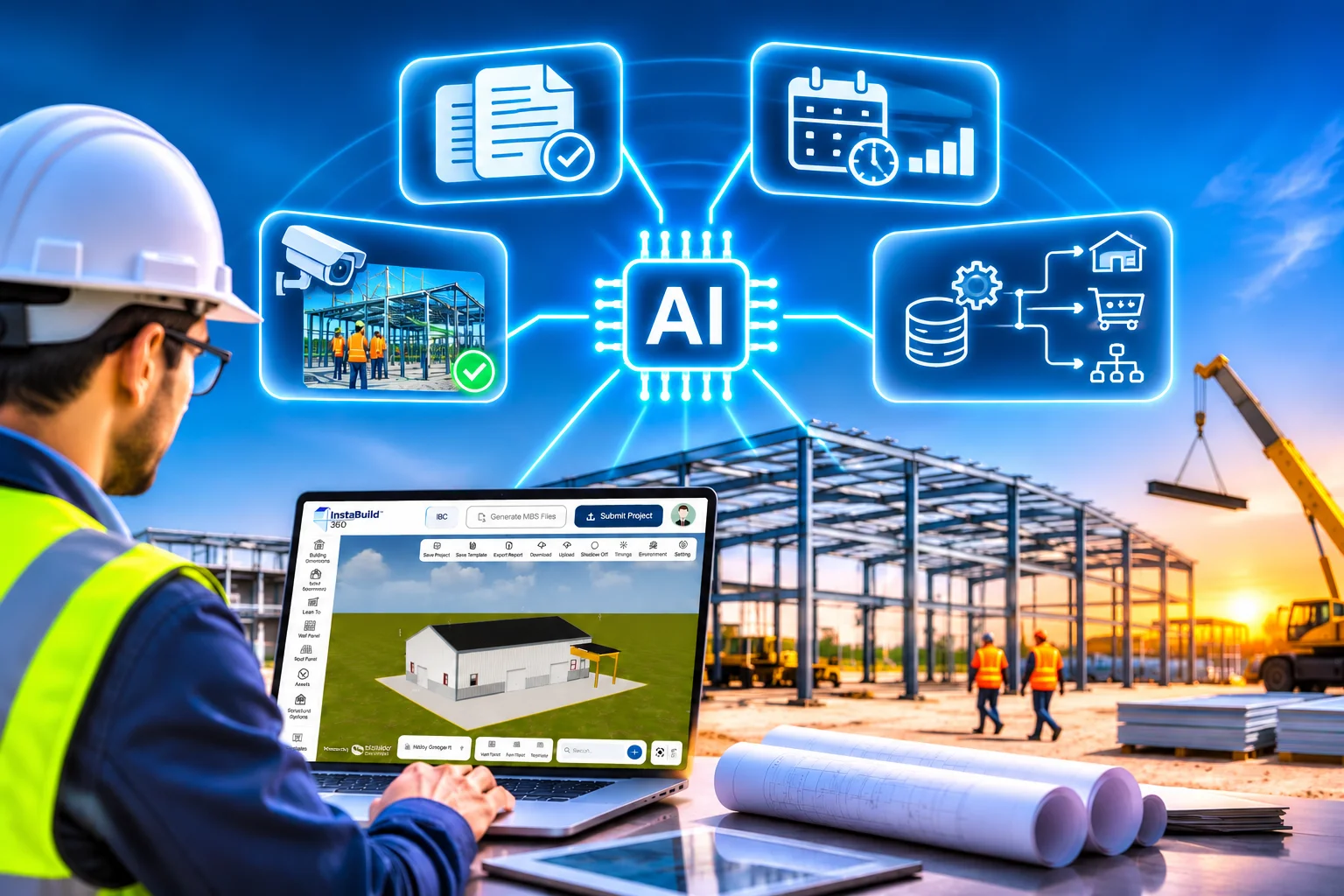
InstaBuild360, a solution by Stridely Solutions, is designed to be a 3D building visualization solution with AI-based guidance for the pre-engineered metal building market, supporting AI for metal building manufacturers.
The value proposition is that it assists in communicating and deliberating a building concept more effectively to the stakeholders. This is helpful in both situations when a customer is not sure what he/she desires and when a salesperson wants to give a more visual explanation of the proposed building.
Also Read: How an Interactive 3D Building Design Improves the Customer
Final Thoughts
While the construction industry is adopting AI, there is a need for technology to add value in solving a specific problem. One of those issues is the disconnect between the customer’s vision and the sales team’s vision for PEMB manufacturers, a challenge that AI in PEMB can help address through clearer visualization.
A 3D building visualizer can help bridge that gap and provide all parties with a more concrete idea to talk about. It can help to guide the discussion and facilitate the process from a concept to a formal proposal alongside good requirement of gathering, estimating, and engineering practices.
It’s not about promising a revision free process. It is to help customers and manufacturers align and make the next decision with greater clarity, supported by AI-powered metal building design and practical metal building automation.
FAQs
Q1. How can AI help PEMB manufacturers prepare faster quotes?
AI can help PEMB manufacturers collect customer requirements, guide building configuration and organize project information. When connected to estimating systems and engineering workflows, these capabilities can support faster quotation preparation. Final pricing still requires validated specifications, material costs and engineering inputs.