Prefabricated metal buildings are selected for their durability, longevity, and cost-efficient scalability. Yet even after submitting an RFQ, many prospective buyers delay or abandon the purchasing process before construction begins.
Across dealer feedback in North America, stalled opportunities are rarely driven by steel gauge or cost per square foot. Instead, they result from buyer-side friction, uncertainty about the finished structure, confusion around customization, delayed revisions, limited confidence in design accuracy, site feasibility concerns, fragmented sales workflows, and an inability to clearly recognize the value being offered.
InstaBuild360 enables pre-engineered metal buildings (PEMB) companies to identify and eliminate these hidden barriers by making the buying journey more visual, structured, and confidence-driven.
Key Takeaways
- Most metal building opportunities are lost because of uncertainty, delayed revisions, and an inability to communicate value, not price.
- Buyer hesitation often reflects the same issues that create construction inefficiencies: inadequate visualization, unclear project requirements, fragmented collaboration, and incomplete planning.
- Buyers are more likely to postpone decisions when they cannot visualize the finished building, understand available customization options, or trust the underlying assumptions.
- Real-time 3D configuration combined with engineering-aware logic transforms uncertainty into informed decision-making.
- Reducing unnecessary back-and-forth before quote approval enables PEMB companies to convert more qualified prospects into signed contracts.
Why Do Metal Building Buyers Hesitate Even After Showing Interest?
Businesses invest in steel buildings because they provide cost-effective expansion opportunities while supporting a wide range of operational requirements. Their flexibility and extensive customization capabilities are among their strongest advantages. However, unlike conventional timber structures, metal buildings require precise coordination of dimensions, openings, site conditions, engineering constraints, and budget considerations.
When buyers encounter unclear visualizations, delayed communication, or misaligned expectations, purchasing momentum slows. That hesitation is often the point at which opportunities are lost. Complexity is a major contributor to this challenge. According to Gartner, 77% of B2B buyers report that their most recent purchase was highly complex or difficult. (Source: Gartner)
Within the PEMB industry, every project is purpose-built. Without sufficient clarity throughout the buying process, complexity becomes a barrier to decision-making rather than a competitive advantage.
Reason 1: Uncertainty About the Final Building Appearance
Static proposal drawings provide only a limited representation of the completed building. They rarely communicate how selected trim, wall panels, roof pitch, openings, and architectural details will appear together in the finished structure. Just as construction should never proceed without approved plans, purchasing decisions become significantly more difficult when buyers cannot clearly visualize the outcome.
Floor plans alone do not enable buyers to evaluate building proportions, architectural aesthetics, brand alignment, or integration with existing facilities. Instead, they are expected to rely on assumptions and assumptions introduce uncertainty.
How InstaBuild360 Helps
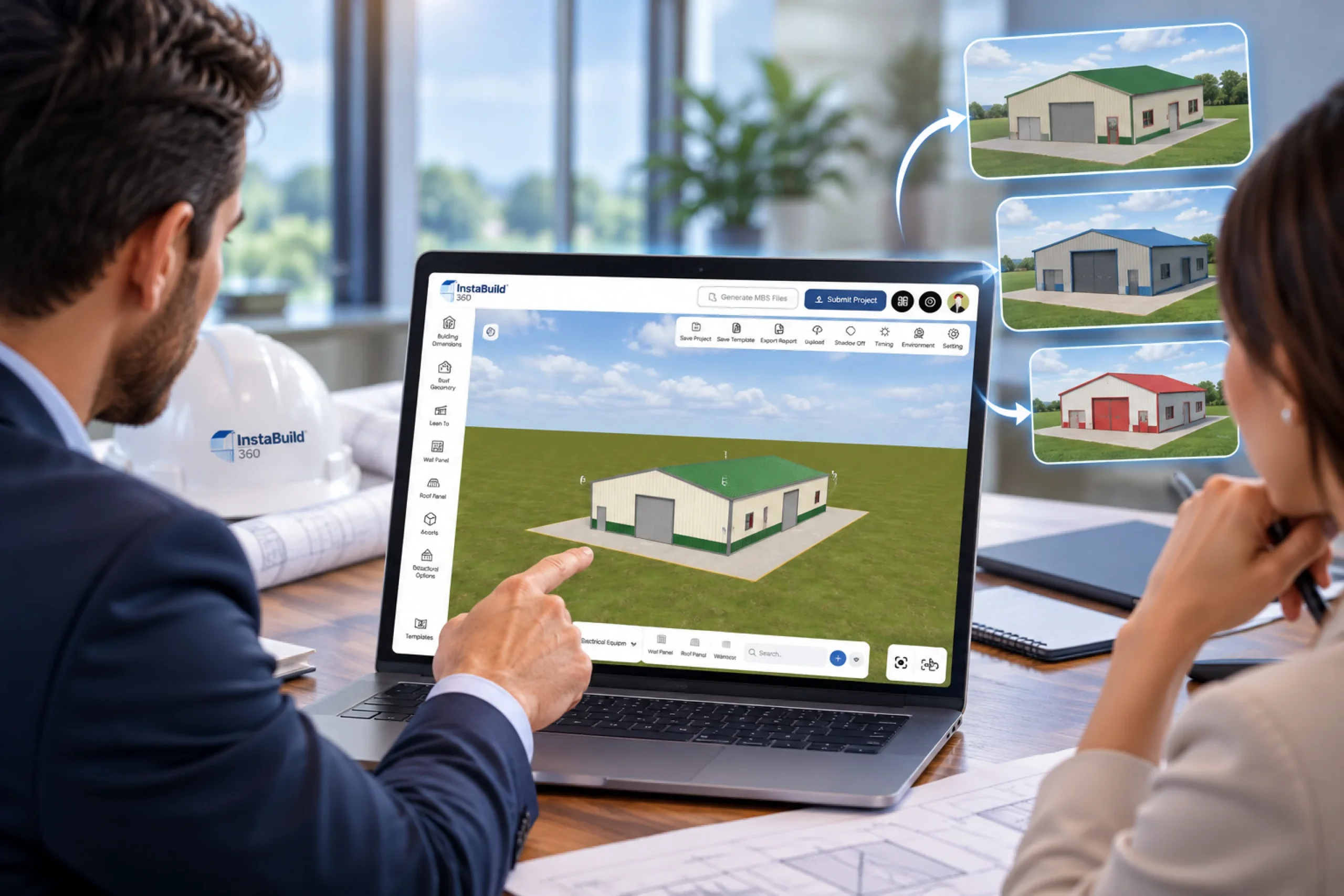
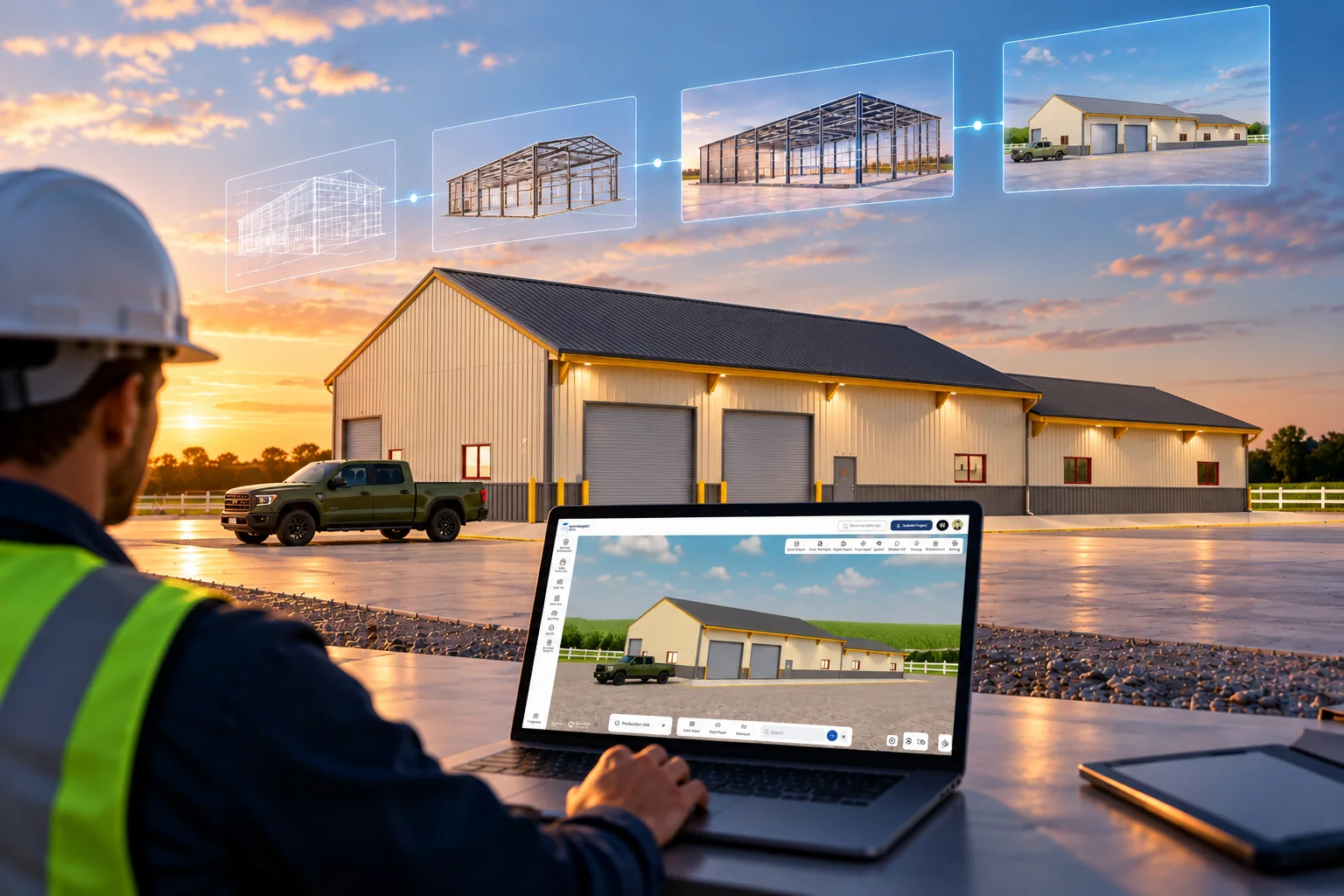
InstaBuild360 provides real-time, interactive 3D visualization that generates engineering-aware building models instantly. Buyers can evaluate accurate digital representations, compare roof configurations, switch between symmetrical and single-slope designs, control wall and roof visibility to inspect structural elements, and simulate real-world conditions such as terrain, sunlight, and available site space.
When buyers can clearly visualize the finished project, uncertainty gives way to confidence.
Reason 2: Confusion Around Customization Options
A steel building is defined by far more than its dimensions. Every project must support a specific operational purpose, whether it is a manufacturing facility with crane systems, a warehouse designed for future racking expansion, or an FDA-compliant food processing plant. Buyers must evaluate numerous configuration choices, including doors, windows, insulation, canopies, louvers, multiple stories, and other functional requirements. Without structured guidance, these decisions quickly become overwhelming.
Decision complexity has a measurable impact on conversion. Salesforce’s State of Sales research reports that 89% of business buyers expect suppliers to understand their unique requirements, while 66% expect real-time engagement throughout the buying process. (Source: Salesforce) When customization support is delayed or fragmented, buyer engagement declines.
How InstaBuild360 Helps
InstaBuild360 simplifies customization through Conversational AI Guidance that supports both buyers and engineering teams throughout the configuration process. When required dimensions are unavailable, the platform intelligently generates an appropriate baseline building. It enables users to modify wall panels, colors, walk doors, windows, louvers, canopies, and other design elements while explaining engineering constraints whenever a requested configuration is not feasible.
Rather than forcing buyers to navigate technical complexity independently, InstaBuild360 transforms customization into a guided, informed, and efficient decision-making experience.
Reason 3: Slow Follow-ups and Delayed Revisions
In construction, every delay extends project timelines, increases coordination effort, and impacts overall efficiency. The same principle applies to the sales process. Each design revision that requires days rather than minutes lengthens the sales cycle, reduces buyer engagement, and increases the likelihood of competitive displacement.
Modern B2B buyers expect responsiveness. When requested changes cannot be demonstrated during the conversation, decision momentum declines, creating opportunities for competitors that can provide immediate answers and live design updates.
How InstaBuild360 Helps
InstaBuild360 enables live configuration during customer engagements, allowing sales teams to modify dimensions, clear heights, bay spacing, accessories, and other design parameters in real time rather than waiting for drafting revisions.
Automated generation of configuration summaries and quotation-ready data enables manufacturers to respond while buyer intent remains strongest. By eliminating unnecessary drafting delays, the platform accelerates approvals and shortens the path from inquiry to contract.
Reason 4: Lack of Confidence in Drawings or Engineering Assumptions
In metal building construction, precision is non-negotiable. The same expectation extends to the sales process. Buyers are unlikely to approve a proposal unless they are confident that the design reflects sound engineering principles, including bay spacing, clear height requirements, crane compatibility, structural bracing, and other critical considerations.
When drawings appear conceptual rather than technically credible, buyers become reluctant to proceed. Uncertainty at this stage often results in delayed approvals, additional revisions, or lost opportunities.
The financial consequences of late-stage design corrections are significant. McKinsey & Company reports that large construction projects typically require 20% more time than originally scheduled and can exceed planned budgets by as much as 80%, with design errors and late-stage changes among the primary contributing factors. (Source: McKinsey & Company)
How InstaBuild360 Helps
Unlike visualization platforms that focus solely on presentation, InstaBuild360 embeds engineering intelligence directly into the configuration workflow.
Built-in engineering rules validate design decisions as configurations are created, ensuring that proposed buildings remain aligned with practical engineering requirements and real-world feasibility. This significantly reduces downstream rework while strengthening buyer confidence that the proposed design closely reflects the building that will ultimately be delivered.
Reason 5: Misalignment Between Buyer Expectations and Technical Feasibility
Selecting an appropriate building site requires consideration of far more than available land. Wind loads, drainage, energy performance, future expansion, and local site conditions all influence long-term project success.
Buyers frequently envision facilities that conflict with site constraints or future operational requirements. Without immediate feedback during the configuration process, these misalignments often remain undiscovered until pricing or engineering begins, introducing avoidable delays and unnecessary redesign.
Industry growth further reinforces the importance of early feasibility validation. According to Statista, U.S. construction spending is projected to exceed USD 2.1 trillion in 2025, increasing demand for efficient project planning and faster decision-making. (Source: Statista)
How InstaBuild360 Helps
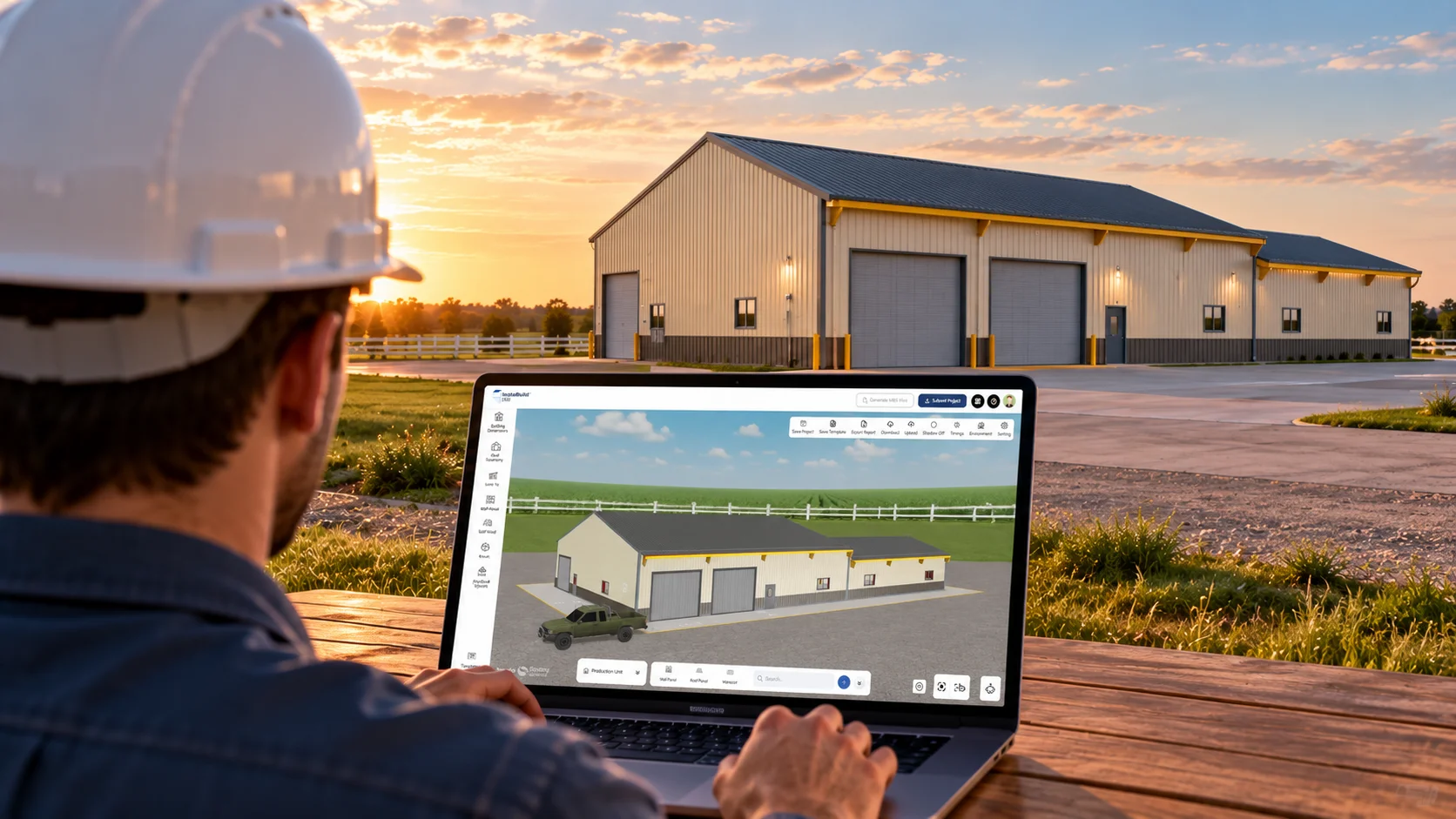
InstaBuild360 enables Environmental and Site Visualization, allowing buyers to evaluate proposed buildings within realistic operating environments before decisions are finalized.
The platform also supports multiple structures and project configurations within a single environment, enabling organizations to evaluate phased expansion strategies from the outset. Rather than treating future growth as an expensive modification, buyers can incorporate long-term planning into the original project scope, improving both confidence and investment value.
Reason 6: Excessive Back-and-Forth Before Quote Approval
Fragmented workflows create inefficiencies in both construction and sales. On a construction site, poor coordination between contractors can lead to misaligned anchor bolts, installation delays, and unnecessary costs. Within the sales process, similar inefficiencies arise when requirements are collected through email, recreated in CAD, and manually entered into CRM and ERP systems.
Each handoff increases the likelihood of delays, inconsistencies, and data loss. Buyers are often required to repeat requirements, while proposals evolve independently of earlier discussions. The result is a slower buying experience and reduced confidence in the accuracy of the final quotation.
Also Read: 8 Ways InstaBuild360 Simplifies Custom Building Sales for Building Manufacturers
How InstaBuild360 Helps
InstaBuild360 consolidates visualization, engineering logic, and AI-driven configuration within a browser-based platform designed specifically for the PEMB industry.
Customer configurations are converted into structured datasets that seamlessly integrate with CRM, estimation, and downstream business systems. Its enterprise-ready integration architecture connects with ERP, CRM, and construction management platforms, enabling design, sales, and delivery teams to operate from a single source of truth.
By eliminating manual re-entry and reducing clarification cycles, InstaBuild360 streamlines the sales process, improves operational efficiency, and accelerates quote approval.
Reason 7: Price Becomes the Only Decision Criterion When Value Is Not Clearly Demonstrated
When buyers cannot clearly understand the value being offered, purchasing decisions inevitably shift toward price comparison. Two proposals may appear identical when presented as static 2D documents, encouraging buyers to select the lower-cost option without recognizing meaningful differences in scope, quality, or long-term value.
This often results in budget discrepancies later in the project when components such as insulation, windows, doors, skylights, or site-specific requirements were not fully understood during the initial evaluation.
Buyer experience plays a significant role in purchasing decisions. PwC reports that 73% of B2B buyers consider the overall buying experience to be an important factor alongside price and product quality. (Source: PwC)
How InstaBuild360 Helps
InstaBuild360 enables buyers to understand the complete value of a proposed building rather than evaluating price alone.
Interactive 3D visualization improves communication by clearly illustrating what is included in the design, why specific configuration choices matter, and how those decisions influence both project cost and future operational flexibility.
Supported by SOC 2 Type I Compliance and rigorous quality engineering practices, InstaBuild360 also provides the reliability and governance expected by enterprise organizations. As a result, discussions shift from cost alone to overall business value and long-term investment confidence.
Concluding Thoughts: Turning Hesitation into Confident Decisions
Buyer hesitation within the PEMB industry is rarely driven by a lack of demand. Organizations continue to invest in metal buildings to support growth, expansion, and operational efficiency. More often, purchasing decisions are delayed because buyers lack sufficient confidence in the proposed solution.
Unclear visualization, slow revisions, fragmented information, and limited transparency introduce unnecessary uncertainty into what is often a significant capital investment.
Addressing these challenges requires a transition from document-centric selling to model-driven engagement. When buyers can visualize the completed building, evaluate customization options with guided assistance, receive immediate engineering-aware feedback, and review a structured project scope within its intended site context, uncertainty is significantly reduced and decision-making becomes more efficient.
InstaBuild360 was developed to support this critical stage of the buying journey. By combining AI, real-time 3D visualization, and engineering intelligence within a browser-based platform, it enables manufacturers to design, configure, and sell metal buildings with greater speed, accuracy, and confidence.
For organizations experiencing stalled opportunities due to uncertainty, delayed revisions, or limited value visibility, the solution is not necessarily a lower price. It is a more transparent, efficient, and confidence-driven buying experience.
Explore the InstaBuild360 platform or schedule a personalized walkthrough to see how it can help accelerate metal building sales while improving the buyer experience.
What types of configurations are available in Instabuild360?
InstaBuild360 supports a wide range of PEB configurations. You can define building dimensions, bay spacing, framing options, roof and wall profiles, and other key design parameters based on your project requirements.